News
Diagnosis of malaria from drop of blood or saliva
Nov 29 2012
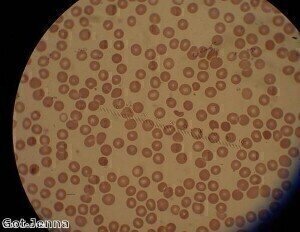
A new method of diagnosing malaria has been discovered from just a single drop of saliva or blood.
Amazingly, the new method may be used in developing countries where there is limited or no access to electricity, clean water, trained staff or expensive equipment.
Malaria can be a life-threatening disease that affects over 200 million people annually. People living or visiting Asia, Africa and Latin America are most at risk.
Caused by the Plasmodium parasite, the disease is spread via infected mosquito bites.
Over half a million people die from this illness every year, even though it can be prevented and treated.
The frequency of actual epidemics has decreased, along with the distribution of the disease due to large-scale monitoring and treatment programmes over the last ten years.
Increasingly sensitive methods of detection have been necessary because of the increase in the amount of people affected with relatively low infection counts of malaria.
That's why researchers at Aarhus University in Denmark have come up with a new highly sensitive method that can diagnose malaria infections.
The new technique involves measuring the activity of an enzyme called topoisomerase I from the Plasmodium parasite.
Rolling Circle-Enhanced Enzyme Activity Detection (REEAD) is the technology developed by the Danish researchers that enables the detection of the disease from a single drop of blood or saliva.
It is cost-effective, time-efficient and does not require specialist staff to perform it on patients.
The new REEAD technology differentiates itself from other quick-test methods as it can determine if a given Plasmodium infection is drug resistant.
"This combination of molecular biologists, doctors, engineers and statisticians has been important for our success in developing the new method," stated associate professor Birgitta Knudsen.
The team at the Department of Molecular Biology and Genetics at Aarhus University has collaborated with the Interdisciplinary Nanoscience Centre, researchers from Denmark (Department of Pathology and Department of Clinical Medicine, Aarhus University Hospital) and overseas (Duke University, University of Rome, University of St Andrews and University of Lyon).
Posted by Ben Evans
Digital Edition
Lab Asia Dec 2025
December 2025
Chromatography Articles- Cutting-edge sample preparation tools help laboratories to stay ahead of the curveMass Spectrometry & Spectroscopy Articles- Unlocking the complexity of metabolomics: Pushi...
View all digital editions









Events
Jan 21 2026 Tokyo, Japan
Jan 28 2026 Tokyo, Japan
Jan 29 2026 New Delhi, India
Feb 07 2026 Boston, MA, USA
Asia Pharma Expo/Asia Lab Expo
Feb 12 2026 Dhaka, Bangladesh




