-
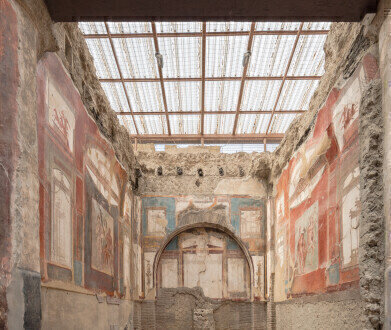 The deceased individual whose brain has been studied was found lying in a bed in the Collegium Augustalium, Herculaneum, Italy. Credit: Wikimedia Commons
 -
Microscopy & microtechniques
Microscopy reveals how brain turned to glass in volcanic eruption at Pompeii
Feb 27 2025
A rare dark coloured ‘organic glass’, which was found inside the skull of an individual who died in Herculaneum / Pompeii during the Mount Vesuvius eruption in 79 CE, was likely formed when they were killed by a very hot – but short-lived – ash cloud which was part of the volcanic ejection.
A team led by Dr. Guido Giordano, Professor of Volcanology within the Department of Science at the Roma Tre University analysed fragments of glass sampled from inside the skull and spinal cord of a deceased individual from Herculaneum, Italy, using X-rays and electron microscopy.
The results indicated that, for the brain to become glass, it must have been heated above at least 510 degrees Celsius before cooling rapidly. The conclusion is based upon analysis of the physical properties of the glass, thought to comprise the fossilised brain of the deceased individual from Herculaneum, who was found lying in their bed in the Collegium Augustalium.
Glass rarely occurs naturally due to the specific conditions required for formation. For a substance to become glass, its liquid form must cool fast enough to not crystallise when becoming solid – requiring a large temperature difference between the substance and its surroundings – and the substance must become solid at a temperature which is well above that of its surroundings.
As a result, it is extremely difficult for an organic glass to form, as ambient temperatures are rarely low enough for water – a key component of all organic matter – to solidify. The only suspected natural organic glass was identified in this case, in 2020 in Herculaneum, but it was not clear how this glass formed.
The authors note that this could not have occurred if the individual was heated solely by the pyroclastic flows which buried Herculaneum, as the temperatures of these flows did not reach higher than 465 degrees Celsius and would have cooled slowly.
The authors therefore conclude – based on observations of modern volcanic eruptions – that a super-heated ash cloud which must have dissipated quickly was the first deadly event during Vesuvius’s eruption.
They theorise that such an event would have raised the individual’s temperature above 510 degrees Celsius, before it rapidly cooled to ambient temperatures as the cloud dissipated. The bones of the individual’s skull and spine likely protected the brain from complete thermal breakdown, allowing fragments to form this astonishing organic glass.
For further reading please visit:
.jpg)
-(2).jpg)


Digital Edition
Lab Asia Dec 2025
December 2025
Chromatography Articles- Cutting-edge sample preparation tools help laboratories to stay ahead of the curveMass Spectrometry & Spectroscopy Articles- Unlocking the complexity of metabolomics: Pushi...
View all digital editions










Events
Jan 21 2026 Tokyo, Japan
Jan 28 2026 Tokyo, Japan
Jan 29 2026 New Delhi, India
Feb 07 2026 Boston, MA, USA
Asia Pharma Expo/Asia Lab Expo
Feb 12 2026 Dhaka, Bangladesh




