Mass spectrometry & spectroscopy
Yale chemists measure proton transfer in water for first time, setting benchmarks for molecular models
Sep 25 2025
Scientists at Yale University use customised mass spectrometer to establish experimental benchmarks that will inform chemical theory and simulation
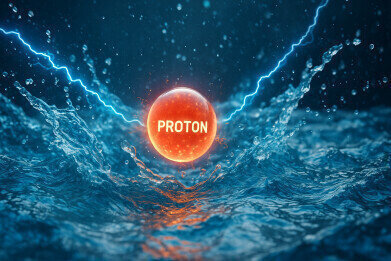
The passage of protons through electrically charged water has been known to underpin processes as diverse as vision, energy storage and rocket propulsion for more than 200 years. Yet until now, scientists have not been able to observe or measure this movement directly at a microscopic scale.
Researchers in the laboratory of Dr. Mark Johnson at Yale University, New Haven, Connecticut have now established – for the first time ever – benchmarks for the time required for protons to move through a network of six water molecules. The study was enabled by a highly customised mass spectrometer that Johnson and his team have spent years refining. The findings have provided experimental and empirical data that could guide theoretical models of proton transfer in chemistry.
“We show what happens in a tiny molecular system where there is no place for the protons to hide,” said Johnson, who is the Arthur T. Kemp Professor of Chemistry in Yale’s Faculty of Arts and Sciences and senior author of the study.
“We’re able to provide parameters that will give theorists a well-defined target for their chemical simulations, which are ubiquitous but have been unchallenged by experimental benchmarks,” he added.
Johnson has devoted decades to developing novel instruments to investigate chemical reactions, such as how electrical charge deforms interconnected networks of water molecules. While water’s capacity to transport positive charge through protons has long been recognised, its quantum mechanical nature has made it exceptionally difficult to measure.
“They aren’t polite enough to stay in one place long enough to let us observe them easily.
“They are thought to conduct the charge through an atomic-scale relay mechanism, in which protons jump from molecule to molecule,” Johnson said.
For the present study, the team examined proton transfer in a system of six water molecules attached to 4-aminobenzoic acid carrying an extra proton. This small, positively charged molecule offered an ideal platform to probe water-mediated proton movement.
“To monitor the movement of the charge, you need a special type of organic molecule that can attach a proton in two different locations that are easily differentiated by the colour of light they absorb,” said Payten Harville, a doctoral candidate in chemistry at Yale’s School of Graduate Studies and co-lead author of the study, alongside fellow doctoral student Abhijit Rana.
“It’s designed so that the only way for protons to get from one docking site to the other is to hitch a ride on a ‘water network taxi’,” she added.
The group employed their adapted 30-foot-long mass spectrometer (around 9.1 metres), housed in Yale’s Sterling Chemistry Laboratory, and ran the system through carefully timed laser interactions.
The instrumentation included electronic systems, optical components and a chamber that cooled molecules to near absolute zero. The molecular assemblies were generated, triggered to react and then destructively analysed for product formation ten times per second.
“It took years to get the instrument to this point,” said Rana.
“And we have finally succeeded in measuring the rate of a chemical reaction that occurs within a finite system.”
Although the intermediate stages of the proton’s journey remained too elusive to capture, the team succeeded in defining parameters for its origin and endpoint.
“We can’t see it in the intermediate, but we know where the proton started and where it ended up.
“And now we know how long it takes to get there,” Johnson said.
The study also included contributions from Thien Khuu, a graduate of the Johnson laboratory who is now a postdoctoral fellow at the University of Southern California.
For further reading please visit: 10.1126/science.ady1723
Digital Edition
Lab Asia Dec 2025
December 2025
Chromatography Articles- Cutting-edge sample preparation tools help laboratories to stay ahead of the curveMass Spectrometry & Spectroscopy Articles- Unlocking the complexity of metabolomics: Pushi...
View all digital editions







Events
Jan 21 2026 Tokyo, Japan
Jan 28 2026 Tokyo, Japan
Jan 29 2026 New Delhi, India
Feb 07 2026 Boston, MA, USA
Asia Pharma Expo/Asia Lab Expo
Feb 12 2026 Dhaka, Bangladesh




