-
-
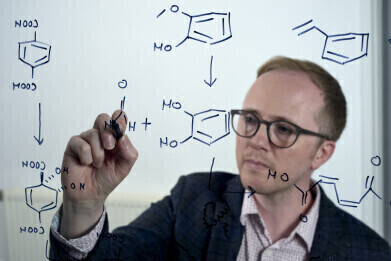 Professor Stephen Wallace. Credit: Edinburgh Innovations and Maverick Photography
 -
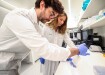
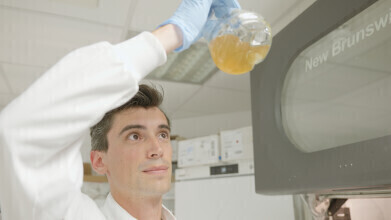 A PhD student checks the growth of a culture of E. coli in the Wallace Lab.. Credit: University of Edinburgh
Research news
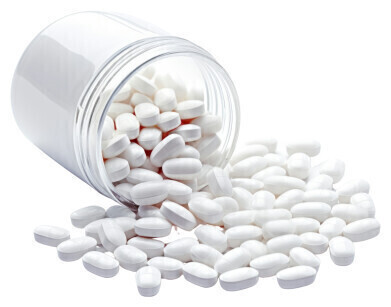
Pain relief from plastic: microbes convert waste into paracetamol
Jun 30 2025
A widely used painkiller could soon be manufactured more sustainably, thanks to a breakthrough that turns plastic waste into paracetamol using engineered microbes.
Researchers at the University of Edinburgh have developed a biotechnological method to transform polyethylene terephthalate (PET) – the plastic found in water bottles and food packaging – into the active ingredient of paracetamol, using genetically modified E. coli. The work, [1] published in Nature Chemistry, demonstrates how synthetic biology can upcycle pollutants into vital medicines.
The team’s approach involved feeding terephthalic acid, a breakdown product of PET, to reprogrammed bacteria in a fermentation system. Within 24 hours and under mild conditions, the microbes had converted nearly 90% of the input material into paracetamol. Notably, the process generated minimal carbon emissions and was carried out at room temperature, presenting a significantly greener alternative to the fossil-fuel-based manufacturing routes currently in use.
“Plastic waste is typically considered an environmental problem,” said Professor Stephen Wallace, Chair of Chemical Biotechnology and lead author. “Our findings show that with the right tools, it can also be a valuable resource.”
Conventional paracetamol production relies on petrochemicals like benzene, extracted from crude oil. The new method offers not just a route to decarbonise part of pharmaceutical manufacturing, but also an avenue for addressing global plastic waste at source.
While further optimisation is needed before scale-up, the research points to a future where ‘living factories’ – microbial strains engineered for specific chemical outputs – could help decouple essential drug production from fossil inputs.
The study was supported by AstraZeneca, the Engineering and Physical Sciences Research Council (EPSRC), and Edinburgh Innovations. It adds to the University’s growing portfolio of research in engineering biology – a field at the intersection of synthetic biology, chemical engineering, and environmental sustainability.
More information online
1. A biocompatible Lossen rearrangement in Escherichia coli published in Nature Chemistry

Digital Edition
Lab Asia Dec 2025
December 2025
Chromatography Articles- Cutting-edge sample preparation tools help laboratories to stay ahead of the curveMass Spectrometry & Spectroscopy Articles- Unlocking the complexity of metabolomics: Pushi...
View all digital editions






Events
Jan 21 2026 Tokyo, Japan
Jan 28 2026 Tokyo, Japan
Jan 29 2026 New Delhi, India
Feb 07 2026 Boston, MA, USA
Asia Pharma Expo/Asia Lab Expo
Feb 12 2026 Dhaka, Bangladesh