-
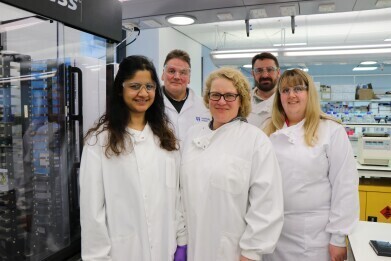 University of Dundee's Drug Discover Unit research team (Credit: University of Dundee)
 -
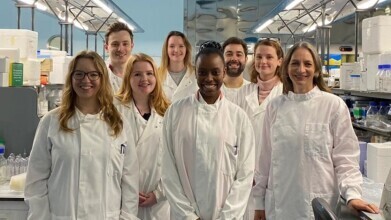 Queen Mary University of London project research team (Credit: QMUL/University of Dundee)
Research news
New tools found to halt cancer cell activity
Mar 15 2024
A discovery by the University of Dundee’s Drug Discovery Unit (DDU) and Queen Mary University of London (QMUL) has identified chemical compounds, or tool molecules, that can halt active cancer cells making them vulnerable for elimination by new drug treatments. The tool molecules were used to forces cells from a specific type of breast cancer into a pro-senescence state in which they can no longer divide or cause tumour growth; this makes them more sensitive to a second group of tool molecules, called senolytic drugs, which can then eliminate them. The process also has the potential to ‘uncloak’ the cancer cells, making them visible to the body’s immune system, offering further therapeutic opportunities.
The research partners developed this ‘two-punch’ method while looking at basal-like breast cancer (BLBC), which is thought to account for around 8-22% of all cases globally, with the highest BLBC incidence in women from Southern Asian and Black ethnic groups. A team funded by Barts Charity and led by Cleo Bishop, Professor of Senescence at QMUL and Academic Lead for the Phenotypic Screening Facility, uncovered a pathway to force BLBC cells into pro-senescence. The collaboration was then established with Dundee’s DDU which led to the development of tool molecules to promote senescence within the cells.
Drug treatments to deliver the ‘second punch’ of cell elimination are currently being developed elsewhere.
Professor Bishop, said, “At present, the most common treatments for BLBC are surgery and unsophisticated chemotherapy regimens. Consequently, the lack of possible targets for tailored therapies and the aggressive clinical course means that women with BLBC have a particularly poor prognosis. Pro-senescence therapies activate a stable cell cycle arrest halting tumour growth, trigger anti-tumour immune responses and expose cancers to novel treatment regimes called senolyitcs.”
During this research high-content imaging from DDU’s diversity libraries was used to identify the tools. The University of Dundee and pharmaceutical company ValiRx, which focuses on early-stage cancer therapeutics and women’s health, have now signed a five year agreement under which the pro-senescent ‘first punch’ tool molecules are the first to be entered into a 12 month evaluation phase. If successful, this could result in a new company being established as a joint venture with all three parties.
Charlotte Green, Head of Business Development at the University of Dundee’s Drug Discovery Unit, said, “The one-two punch approach has gained lots of interest in recent years but currently there is no clinical precedent, by moving the project forward with ValiRx we are leading the way in translating the research to the clinic.”
Dr Suzy Dilly, CEO of ValiRx said, “The strength of the DDU and research facilities at Dundee are very impressive and having reviewed multiple projects from teams there over the past year, we believe that this evaluation agreement will be the first of a series of new projects that can be brought into our pipeline.”
More information online


Digital Edition
Lab Asia Dec 2025
December 2025
Chromatography Articles- Cutting-edge sample preparation tools help laboratories to stay ahead of the curveMass Spectrometry & Spectroscopy Articles- Unlocking the complexity of metabolomics: Pushi...
View all digital editions








Events
Jan 21 2026 Tokyo, Japan
Jan 28 2026 Tokyo, Japan
Jan 29 2026 New Delhi, India
Feb 07 2026 Boston, MA, USA
Asia Pharma Expo/Asia Lab Expo
Feb 12 2026 Dhaka, Bangladesh




