-
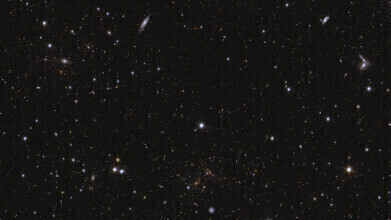 Euclid Deep Field South, 70x zoom / Credit: ESA/Euclid/Euclid Consortium/NASA, image processing by J.-C. Cuillandre, E. Bertin, G. Anselmi
 -
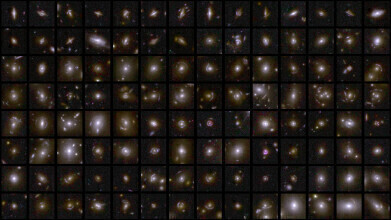 Strong gravitational lenses captured by Euclid. Credit: ESA/Euclid/Euclid Consortium/NASA, image processing by M. Walmsley, M. Huertas-Company, J.-C. Cuillandre
 -
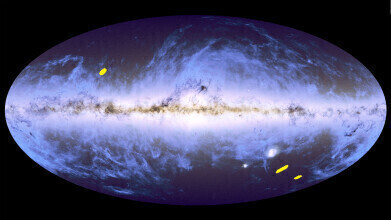 Location of Euclid Deep Fields on Gaia and Planck sky map / Credit: ESA/Euclid/Euclid Consortium/NASA; ESA/Gaia/DPAC; ESA/Planck Collaboration
Research news
Euclid mission unveils dark matter and cosmic discoveries
Apr 04 2025
Cutting-edge UK research is driving discoveries in the European Space Agency’s Euclid mission, with new data shedding light on dark energy and matter. The latest findings reveal 500 galaxies exhibiting strong gravitational lensing, where the gravity of closer galaxies bends the light from more distant ones - offering insights into the mysterious dark matter shaping our universe.
Euclid’s data is revolutionising the study of gravitational lensing, combining AI-driven techniques with citizen science efforts. Over 1,000 volunteers have helped analyse images, accelerating the discovery process.
A game-changer for space science
Launched in July 2023, Euclid carries a UK-designed visible imager (VIS) funded by £37 million from the UK Space Agency. Developed by a UCL-led team, the 609-megapixel camera can capture billions of galaxies up to 10 billion light years away. The new dataset includes observations of distant galaxies and transient phenomena such as supernovae, gamma-ray bursts, and fast radio bursts - allowing scientists to study cosmic events in unprecedented detail.
UK Science Minister Lord Vallance highlighted the nation’s contribution:
"The UK space sector is central to the Euclid mission, providing advanced imaging technology and data processing tools. The breakthroughs from this mission will not only deepen our understanding of the universe but also enhance data analysis capabilities that benefit industries on Earth."
Professor Carole Mundell, ESA’s Director of Science, called Euclid the “ultimate discovery machine,” emphasising its ability to survey galaxies at an unprecedented scale.
Citizen science and AI: A winning combination
The project’s success is powered by a unique blend of machine learning and human collaboration. Citizen scientists using the Zooniverse platform helped identify 500 new gravitational lenses - doubling the known count.
“This early data showcases Euclid’s incredible potential,” said Dr Aprajita Verma from the University of Oxford. “Even with just 0.5% of the survey area, we’ve uncovered millions of galaxies in breathtaking detail.”
UK institutions played a pivotal role in Euclid’s mission, with contributions from the Mullard Space Science Laboratory, XCAM Ltd., and Teledyne Space Imaging. Professor Mike Lockwood, President of the Royal Astronomical Society, summed it up:
“Euclid is just getting started. With each new data release, we move closer to unlocking the universe’s biggest mysteries - what it’s made of, how it evolved, and where it’s heading.”
More information online


Digital Edition
Lab Asia Dec 2025
December 2025
Chromatography Articles- Cutting-edge sample preparation tools help laboratories to stay ahead of the curveMass Spectrometry & Spectroscopy Articles- Unlocking the complexity of metabolomics: Pushi...
View all digital editions






Events
Jan 21 2026 Tokyo, Japan
Jan 28 2026 Tokyo, Japan
Jan 29 2026 New Delhi, India
Feb 07 2026 Boston, MA, USA
Asia Pharma Expo/Asia Lab Expo
Feb 12 2026 Dhaka, Bangladesh