-
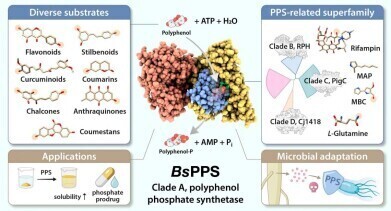 The newly identified enzyme, phenolic phosphate synthetase (BsPPS), can modify over 30 types of natural compounds - including flavonoids and stilbenoids - by adding monophosphate groups. This biocatalytic approach could make phenolic nutraceuticals and medicines more soluble and effective. What’s more, similar enzymes are widespread in Bacillus species but remain largely unexplored, hinting at a hidden enzyme toolkit with big potential for future health and green chemistry applications. Credit National Taiwan University
Research news
Bacillus enzyme unlocks greener, more effective nutraceuticals
Sep 09 2025
Researchers at National Taiwan University have discovered a versatile enzyme from Bacillus subtilis that could make natural health compounds and medicines more effective and water-soluble. The study [1], published in ACS Catalysis, provides a sustainable alternative to traditional chemical methods for improving drug solubility.
The enzyme, called phenolic phosphate synthetase (BsPPS), can attach phosphate groups to over 30 different natural compounds, including flavonoids, stilbenoids, curcuminoids, and more. Phosphorylation increases water solubility, helping compounds be better absorbed in the body - a common challenge in developing nutraceuticals and prodrugs.
“This is the first time one enzyme has been shown to modify such a diverse range of phenolic compounds,” said Professor Nan-Wei Su, corresponding author of the study. “It suggests bacteria may naturally use similar strategies to process these molecules in their environment.”
BsPPS works through a two-step mechanism: it captures a pyrophosphate from ATP, temporarily holds it on a histidine site, and then transfers the phosphate to the target compound. Bioinformatic analysis indicates that BsPPS belongs to a largely unexplored family of enzymes widely distributed in bacterial genomes, hinting at a rich resource of biocatalysts yet to be discovered.
By offering a biocatalytic, precise, and environmentally friendly approach, BsPPS could simplify the creation of phosphate prodrugs and water-soluble nutraceuticals, supporting the next generation of health products with improved bioavailability.
“Using these enzymes, we can envision a greener, more selective way to produce medicines and supplements that work better in the body,” said Professor Su.
More information online
1. Molecular Insights into a Promiscuous Dikinase Catalyzing Monophosphorylation of Structurally Diverse Natural Polyphenols published in ACS Catalysis



Digital Edition
Lab Asia Dec 2025
December 2025
Chromatography Articles- Cutting-edge sample preparation tools help laboratories to stay ahead of the curveMass Spectrometry & Spectroscopy Articles- Unlocking the complexity of metabolomics: Pushi...
View all digital editions









Events
Jan 21 2026 Tokyo, Japan
Jan 28 2026 Tokyo, Japan
Jan 29 2026 New Delhi, India
Feb 07 2026 Boston, MA, USA
Asia Pharma Expo/Asia Lab Expo
Feb 12 2026 Dhaka, Bangladesh




