-
-
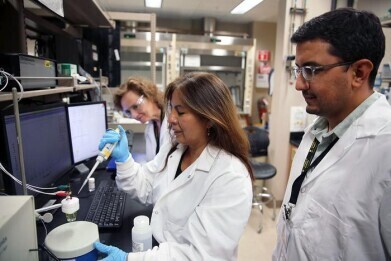 UCF chemists Dr. Yulia Gerasimova and Dr. Karin Chumbimuni-Torres collaborated with Dr. Daniel Ram, assistant professor of medicine and infectious disease expert, to develop a new biosensor test to detect both Hepatitis and HIV at the same time. Credit Photo by UCF
Research news
UCF scientists develop low-cost test to detect hepatitis B, hepatitis C and HIV viruses at same time
Nov 07 2025
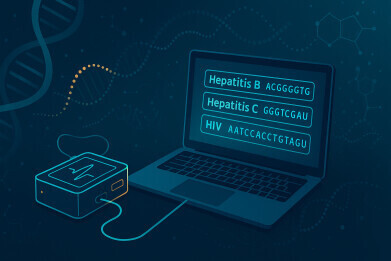
A multidisciplinary research team at the University of Central Florida has received US $537,619 from the National Institutes of Health to advance a novel electrochemical biosensor capable of identifying hepatitis B, hepatitis C and HIV infection at once. The innovation aims to deliver rapid, accurate viral diagnostics in low-resource settings worldwide
Researchers at the University of Central Florida (UCF) have been awarded a grant totalling US $537,619 by the National Institutes of Health (NIH) to develop a low-cost, accurate diagnostic test capable of detecting Hepatitis B, Hepatitis C and Human Immunodeficiency Virus infection (HIV) concurrently.
For many diseases, early detection has led to better patient outcomes. The UCF team, drawn from the College of Medicine and the College of Sciences, plan to repurpose an existing electrochemical biosensor so that it can identify those viruses at the ribonucleic-acid (RNA) level and quantify viral loads in resource-limited settings.
There is a global need for such a diagnostic test. According to data from the World Health Organization more than 300 million people live with either hepatitis B or hepatitis C and more than 40 million people live with HIV. Simultaneous testing has the potential to reduce viral transmission, enable earlier hepatitis diagnosis and thereby lower the risk of liver failure, cirrhosis and liver cancer. Access to faster and easier-to-use testing may also reduce barriers to patient care and assist clinicians in refining treatment plans.
“It’s very important to detect those viruses in the same sample because those viruses share the same route of transmission and it increases the chance that the same person may get multiple viruses,” said Dr Yulia Gerasimova, associate professor of chemistry working on the project. “Doctors need to know how to tailor the treatment for patients depending on if they have a co-infection or not.”
Existing diagnostics for both hepatitis and HIV require a blood test and analysis in a clinical laboratory. That requirement has made testing challenging in remote or low-resource regions of the world, where the time to obtain results can stretch into months. During that interval undiagnosed patients may become sicker and the infection may spread.
“I think the goal is to have something that’s accessible worldwide – regardless of the environment,” said Dr Daniel Ram, assistant professor of infectious disease at UCF, who is contributing to the project. “Having the capacity to detect multiple viruses at once really has potential to benefit everyone.”
Dr Ram recalled his childhood in Guyana where his mother directed a national clinic that lacked onsite capacity to process those samples. “In order to quantify viruses and patient samples, we would have to ship the samples out to Miami or sometimes Trinidad and Tobago. During shipping those samples degraded and the possibility for failure is high. In the meantime, doctors didn’t know how to best treat the patients.”
The research team aim to reshape patient care by delivering a more accessible and affordable diagnostic for use in low-resource settings, said Dr Karin Chumbimuni-Torres, associate professor of chemistry and project lead. Rather than relying on current blood tests that measure the body’s immune response to each virus and distinct viral loads, the UCF researchers intend to apply their sensor technology to detect both viruses via RNA. They envision that collected samples, such as blood, could be screened with the sensor directly.
Dr Chumbimuni-Torres developed similar sensor technology to detect Dengue fever and the Zika virus disease. Her preliminary results enabled her to secure NIH funding for the hepatitis and HIV work. The HIV virus frequently mutates so the UCF scientists programmed their sensor to detect any serotype of the disease. “This is key,” said Dr Chumbimuni-Torres. “HIV can mutate a lot so we made a technique that can detect any of the mutations.”
Because their biosensor conducts genetic testing on the viruses, the scientists can target the different genetic sequences of both viruses. “We want to quantify the virus so doctors can know how to treat patients,” Dr Chumbimuni-Torres added.
Through the research the team hope to ensure the technology will work regardless of the viral genome source, Dr Gerasimova said. “We’re using something called isothermal amplification to amplify viral nucleic acids for them to be detected with virus-specific probes,” she said. “This project is more or less exploratory and we’re developing and fine-tuning our technique along the way.”
Dr Ram’s role is to characterise the viruses and determine how best to measure viral load from a patient’s serum while his collaborators evaluate the efficacy of the sensor technology. “We want to test whether or not the sensors can detect certain amounts of virus and how that would relate to how that may manifest in patients,” he said. “For this round of experimentation we need to validate with cell cultures and having different quantified amounts of the viruses. Knowing how many viral particles it’s able to detect will allow us to move forward in assessing a patient cohort.”
As the research has progressed Dr Ram sees the potential for the test to improve the lives of patients worldwide. “This technology has immediate benefit if we can show it to work effectively in detecting multiple viruses,” he said.
Dr Chumbimuni-Torres is an associate professor in the Department of Chemistry at UCF. She earned her master’s and doctoral degrees at the University of Campinas, São Paulo, Brazil. After graduating she held post-doctoral research posts at Purdue University and the University of California, San Diego and worked at the Biodesign Institute at Arizona State University. Before joining UCF she served as a research associate at the University of Texas at San Antonio. Her research interests focus on sensor chemistry for biological applications including analysing micro-RNAs, RNA and DNA and studying interactions at the interface of biomolecules and nanomaterials.
Dr Gerasimova is an associate professor in the UCF Department of Chemistry, where she leads the Nucleic Acid Function and Diagnostics Laboratory. She earned her doctoral degree in bio-organic chemistry from the Siberian Branch of the Russian Academy of Sciences, Russia. She joined UCF in 2010 as a post-doctoral researcher and moved into a faculty role in the autumn of 2016.
Dr Ram is an assistant professor of medicine at UCF’s Burnett School of Biomedical Sciences. His laboratory studies how infection and disease modulate RNA-splicing and lead to dysfunctional immune responses. Dr Ram obtained his PhD in Immunology at Tufts University in 2016 and then served as a post-doctoral research fellow for four years at the Center for Virology and Vaccine Research at Beth Israel Deaconess Medical Center and Harvard Medical School in Boston. He subsequently worked as an instructor in medicine at Harvard before joining UCF in 2023.
The project now provides a promising route to deliver a novel diagnostic solution for simultaneous detection of hepatitis B, hepatitis C and HIV infection in settings where traditional laboratory infrastructure is scarce.
Digital Edition
Lab Asia Dec 2025
December 2025
Chromatography Articles- Cutting-edge sample preparation tools help laboratories to stay ahead of the curveMass Spectrometry & Spectroscopy Articles- Unlocking the complexity of metabolomics: Pushi...
View all digital editions









Events
Jan 21 2026 Tokyo, Japan
Jan 28 2026 Tokyo, Japan
Jan 29 2026 New Delhi, India
Feb 07 2026 Boston, MA, USA
Asia Pharma Expo/Asia Lab Expo
Feb 12 2026 Dhaka, Bangladesh




