Research news
Researchers in Japan engineer a gel that enables laboratory first ‘slow-twitch’ muscle fibres to grow
Nov 12 2025
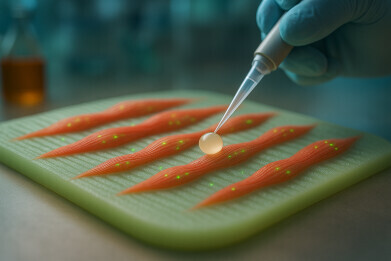
Researchers in Japan have created a biomimetic gelatin gel that replicates the softness and microstructure of slow-twitch muscle tissue, allowing muscle precursor cells to develop genetic and metabolic traits essential for endurance, posture, and glucose regulation. The discovery could pave the way for regenerative therapies and precision drug testing
A research team from the National Institutes for Quantum Science and Technology (QST) and Tokyo Metropolitan University, Japan, has developed a biomaterial that has the potential to transform therapies for muscle degeneration and metabolic disorders. By replicating the softness and microscopic structure of slow-twitch muscle tissue, the team has cultivated laboratory-grown muscle cells that show the genetic and metabolic hallmarks of slow-twitch fibres, which are essential for posture, endurance and glucose regulation.
Slow-twitch fibres play a fundamental role in maintaining mobility and metabolic balance, particularly among older adults and those with chronic illnesses. Attempts to reproduce their properties in vitro have long proved difficult, as conventional culture systems cannot mimic the fibrous and compliant nature of living muscle tissue hindering research into the development of regenerative therapies.
Led by Dr Mitsumasa Taguchi, the QST group used a radiation-induced crosslinking method to produce a gelatin-based gel with precisely controlled elasticity and surface microgrooves. When mouse muscle precursor cells, known as C2C12 myotubes, were cultured on the softest version of this gel, with an elasticity of 10 kilopascals, the cells expressed genes typical of slow-twitch fibres such as MYH7 and MYH2, together with metabolic markers including GLUT4 and myoglobin. Levels of PGC-1α, a key regulator of slow-twitch muscle development, also increased significantly.
“Our gel provides a microenvironment that closely resembles the physical conditions inside the body.
“This allows muscle cells to develop in a way that mirrors natural slow-twitch muscle formation which has never been achieved with conventional materials,” said Dr Taguchi.
The study also showed that introducing microgrooves to the gel surface promoted cell alignment and differentiation, although these structural changes alone did not trigger the expression of slow-twitch genes. The results indicate that elasticity is the dominant factor in driving fibre-type transitions, while surface topography contributes to the overall organisation of muscle architecture.
The implications of this work extend across regenerative medicine and biomedical engineering. Artificial slow-twitch muscle tissue could serve as a platform for drug testing, disease modelling, or transplantation therapy. Because the gelatin gel is both biocompatible and biodegradable, it may eventually act as a scaffold to repair damaged muscle in patients affected by age-related muscle loss or metabolic dysfunction.
“In the long term, this technology could help extend healthy life expectancy and improve quality of life.
“It opens new doors for personalised medicine and advanced biomedical engineering,” said Dr Taguchi.
In Japan, the National Institutes for Quantum Science and Technology was established in 2016 through the merger of the National Institute of Radiological Sciences and operations of the Japan Atomic Energy Agency and promotes quantum science and technology research.
Dr Taguchi, who leads research at the Department of Advanced Functional Materials Research at QST’s Takasaki Institute for Advanced Quantum Science, is a recognised expert in radiation-based biomaterials engineering. His research focuses on the precise control of polymeric materials such as silicone and collagen to optimise their functionality and biocompatibility.
For further reading please visit: 10.1038/s41598-025-12744-7


Digital Edition
Lab Asia Dec 2025
December 2025
Chromatography Articles- Cutting-edge sample preparation tools help laboratories to stay ahead of the curveMass Spectrometry & Spectroscopy Articles- Unlocking the complexity of metabolomics: Pushi...
View all digital editions









Events
Jan 21 2026 Tokyo, Japan
Jan 28 2026 Tokyo, Japan
Jan 29 2026 New Delhi, India
Feb 07 2026 Boston, MA, USA
Asia Pharma Expo/Asia Lab Expo
Feb 12 2026 Dhaka, Bangladesh




