Research news
European Research Council awards 1.5 million euros to study RNA bacteriophages, antibiotic resistance
Sep 19 2025
Professor Jens Hör of the Helmholtz Institute for RNA-based Infection Research, Würzburg, Germany has received a prestigious European Research Council Starting Grant worth 1.5 million euros. His project, ‘RIBO-PHAGE’, will investigate ribonucleic acid bacteriophages as potential therapeutic agents against multi-resistant bacteria and explore their molecular biology to advance infection research and antimicrobial therapies
Infections caused by antibiotic-resistant bacteria pose an increasingly serious threat to global health, and science continues to search for effective alternatives to conventional antibiotics. One promising avenue of discovery are bacteriophages – or simply ‘phages’ – which are viruses that infect and destroy bacteria.
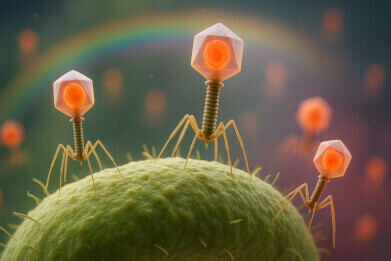
Phages attach to bacterial cells, inject their genetic material, and in so doing convert the bacterium into a ‘factory’ for viral replication to the point where its cell wall open bursts and releases more phages to find more bacteria.
Bacteriophages are the subject of research led by Professor Hör at the Helmholtz Institute for RNA-based Infection Research (HIRI) in Würzburg, Germany. The institute is part of the Helmholtz Centre for Infection Research (HZI) in cooperation with Julius-Maximilians-Universität Würzburg. Hör has now received a Starting Grant of 1.5 million euros from the European Research Council (ERC) for his project, ‘RIBO-PHAGE’.
“The rising [threat of] antibiotic resistance is one of the most pressing challenges of our time. This makes it all the more gratifying that the ERC awarded a Starting Grant to junior professor Jens Hör.
“Thanks to this funding award [Hör] will be able to continue his pioneering research at the highest level,” said Professor Jörg Vogel, managing director of HIRI.
“Phages have the potential to become a game changer in everyday clinical practice, especially in the fight against multi-resistant bacteria,” said Professor Josef Penninger, Scientific Director of the HZI.
Although therapeutic uses of phages dates back to the 20th century – and in particular in the former Soviet Union – their clinical application declined after the success of antibiotics. Recent studies have revived interest in phage therapy, which has not only revealed their therapeutic promise but also provided insights into the origins of the human innate immune system.
Researchers have also reported progress in adapting phages to treat infections caused by multi-resistant bacteria.
Despite this resurgence, RNA phages – which carry ribonucleic acid rather than deoxyribonucleic acid (DNA) – remain largely unstudied.
“While DNA phages have a head and a tail, RNA phages consist only of a head,” explained Hör in how their biology differs markedly from that of DNA phages.
However, only a few RNA phages have so far been identified, and his ERC-funded project aims to define how these phages regulate their replication, exploit host mechanisms, and confront bacterial defence systems.
“Understanding these mechanisms of action facilitates the effective use of RNA phages as therapeutic agents. It also bears the potential to discover entirely novel biotechnological tools,” said Hör. His work will focus on RNA phages from the Fiersviridae and Cystoviridae families, which infect bacteria of the genera Escherichia and Pseudomonas, to map the molecular processes of infection.
Hör is the fifth HIRI group leader to have secured ERC funding. A graduate of the University of Bonn, Hör earned his doctorate from the University of Würzburg in 2020, where he studied bacterial RNA–protein complexes. He subsequently worked at the Weizmann Institute of Science, in Israel, on bacterial anti-phage defence mechanisms. Since 2024, he has led a research group at HIRI and has been a junior professor at Würzburg.
The ERC Starting Grant supports young researchers within seven years of their doctorate to establish independent careers. Grants provide up to five years of funding with a maximum of 1.5 million euros, awarded solely on the basis of scientific excellence.



Digital Edition
Lab Asia Dec 2025
December 2025
Chromatography Articles- Cutting-edge sample preparation tools help laboratories to stay ahead of the curveMass Spectrometry & Spectroscopy Articles- Unlocking the complexity of metabolomics: Pushi...
View all digital editions









Events
Jan 21 2026 Tokyo, Japan
Jan 28 2026 Tokyo, Japan
Jan 29 2026 New Delhi, India
Feb 07 2026 Boston, MA, USA
Asia Pharma Expo/Asia Lab Expo
Feb 12 2026 Dhaka, Bangladesh




