-
 Credit: Karl-Erik Piirimees
 -

-
Research news
Estonian study reveals medications can leave a lasting effect on the gut's microbiome
Sep 26 2025
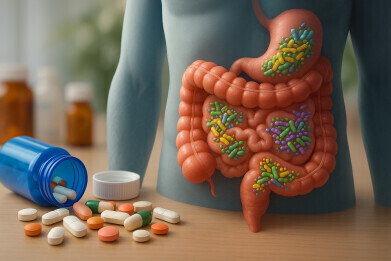
Researchers at the University of Tartu Institute of Genomics have shown that common medications – including antidepressants, proton pump inhibitors and antibiotics – can leave imprints on the gut microbiome that persist for years after treatments end
Medications taken years earlier can continue to shape the human gut microbiome, according to a large-scale investigation by the University of Tartu Institute of Genomics, in Estonia.
The team analysed stool samples and the records of prescription medication from more than 2,500 participants in the Estonian Biobank’s Microbiome cohort. They found that most classes of drugs were linked to changes in microbial composition, and that many of these effects remained detectable long after patients had stopped treatment. The impact extended beyond antibiotics: antidepressants, beta-blockers, proton pump inhibitors and benzodiazepines all left microbial signatures.
“Most microbiome studies only consider current medications [being taken by a patient] but our results show that past drug use can be just as important as it is a surprisingly strong factor in explaining individual microbiome differences,” said Dr Oliver Aasmets, lead author. He noted that this finding underlined the importance of accounting for drug history when exploring links between the microbiome and disease.
The study reported that benzodiazepines, commonly prescribed for anxiety, produced microbiome effects on a scale similar to broad-spectrum antibiotics. The researchers also observed that drugs from the same therapeutic class, such as diazepam and alprazolam, could differ markedly in the extent to which they altered the microbiome.
Follow-up samples from a subset of participants confirmed that the initiation or cessation of certain drugs caused predictable microbial shifts, supporting a causal relationship. Although the second time-point analysis involved a relatively small sample size, the team verified lasting effects from proton pump inhibitors, selective serotonin reuptake inhibitors and antibiotics including macrolides and penicillin combinations.
“This is a comprehensive systematic evaluation of long-term medication effects on the microbiome using real-world health records.
“We hope this encourages researchers and clinicians to factor in medication history when interpreting microbiome data,” said Professor Elin Org, corresponding author.
For further reading please visit: 10.1128/msystems.00541-25



Digital Edition
Lab Asia Dec 2025
December 2025
Chromatography Articles- Cutting-edge sample preparation tools help laboratories to stay ahead of the curveMass Spectrometry & Spectroscopy Articles- Unlocking the complexity of metabolomics: Pushi...
View all digital editions










Events
Jan 21 2026 Tokyo, Japan
Jan 28 2026 Tokyo, Japan
Jan 29 2026 New Delhi, India
Feb 07 2026 Boston, MA, USA
Asia Pharma Expo/Asia Lab Expo
Feb 12 2026 Dhaka, Bangladesh




