-
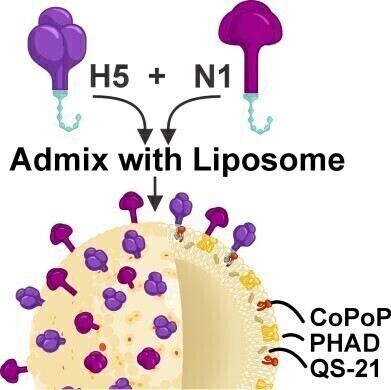 The illustration, above, shows the experimental bird flu vaccine platform. The H5 and N1 proteins attach via his-tag (teal coil) to cobalt ions (red plug) within the cobalt-porphyrin-phospholipid nanoparticle. PHAD and QS-21 are adjuvants embedded into nanoparticle. Credit: University at Buffalo, NY, USA
Research news
Animal model of experimental H5N1 avian flu vaccine shows promise
Apr 23 2025
Proven effective for COVID-19, vaccine platform could be key in responding to evolving bird flu strains
A developmental vaccine has shown complete protection in mouse models against the H5N1 variant of the avian influenza virus. The work by University at Buffalo (UB), New York, USA, focused on the H5N1 strain called 2.3.4.4b, which has caused severe outbreaks in wild birds and poultry, but has also infected dairy cattle – and among other mammals – domestic cats and sea lions.
In the study, the research team outline the process they have developed to create vaccine doses with precise amounts of the two proteins – haemagglutinin (H5) and neuraminidase (N1) – which primes the body’s immune system to be able to fight avian flu.
The experimental platform has the potential to bring about a step change in the way vaccines are used against avian influenza. Currently there are only a handful of bird flu vaccines that are approved for human use.
The method could take a step toward more potent, versatile and easy-to-produce vaccines that public health officials believe will be needed to counteract the evolving avian flu strains that are evolving away from the protection of existing vaccines.
“While the results are extremely encouraging, we have a lot more work to do,” said Dr. Jonathan Lovell, the study’s lead author and professor in the Department of Biomedical Engineering at UB.
Lovell has been experimenting with the vaccine platform for more than a decade. It consists of nanoparticles made from cobalt and porphyrin with an outer shell of phospholipid – he calls it ‘CoPoP’ for short.
The vaccine platform was tested in mice with 2.3.4.4b, using three experimental criteria, doses which contained H5 alone, N1 alone, and H5 and N1 combined, finding:
- H5 alone provided complete protection, with no signs of illness, weight loss nor detectable virus in the lungs.
- N1 alone gave partial protection. It was roughly 70% effective, with some mice showing symptoms and viral presence.
- H5 and N1 together – a bivalent vaccine – also provided complete protection.
The results demonstrated the role that H5 plays in developing immunity to bird flu, said , Lovell.
H5 – in its viral form – itself allows the virus to enter and attach itself to host cells where it then starts to replicate. But a vaccine with a small, safe dose of H5 prompts the body to recognise, remember and destroy it.
N1, meanwhile, acts as an enzyme in its viral form to clip residues from the host cell, and help the replicated virus to spread in the body.
“N1 antibodies are still incredibly important [even if] they are non-neutralising. [Consequently, N1 helps] reduce viral replication and the severity of illness,” Lovell said. “Bivalent formulations could be extremely advantageous as H5N1 evolves.”
To create the experimental avian flu vaccine, the researchers added what’s called a histidine tag – a ‘his-tag’ – to both the H5 and N1. His-tags are short strings of amino acids that have a natural affinity for metals. When mixed with CoPoP nanoparticles, the his-tag proteins form a strong bond with cobalt ions.
“It’s kind of like a magnet attaching itself to a metal surface. It just clicks into place. It’s fast and efficient, which is advantageous when you need to quickly ramp up vaccine production,” said Lovell.
To make the vaccine more potent, the researchers added two immune-boosting adjuvants – QS-21 and a synthetic monophosphoryl lipid A. The adjuvants are mixed into the phospholipid layer.
Unlike currently approved vaccines (which use live or dead versions of H5N1) as a recombinant protein vaccine, it relies on only parts of the genetic material – H5 and N1 – from the virus to stimulate the immune response.
“Our vaccine does not require eggs in the manufacturing process – as with many current influenza vaccines – this platform is potentially faster and more efficient way to deliver protective vaccines,” Lovell said.

Digital Edition
Lab Asia Dec 2025
December 2025
Chromatography Articles- Cutting-edge sample preparation tools help laboratories to stay ahead of the curveMass Spectrometry & Spectroscopy Articles- Unlocking the complexity of metabolomics: Pushi...
View all digital editions










Events
Jan 21 2026 Tokyo, Japan
Jan 28 2026 Tokyo, Japan
Jan 29 2026 New Delhi, India
Feb 07 2026 Boston, MA, USA
Asia Pharma Expo/Asia Lab Expo
Feb 12 2026 Dhaka, Bangladesh




