Laboratory products
German laser manufacturer nanoplus is using the Yokogawa AQ6375 optical spectrum analyser to verify the high spectral quality of its distributed feedback (DFB) lasers using a spectral characterisation technique based on molecular excitation.
A highly accurate method for the detection of gases in low concentrations is based on the use of laser light. This technique relies on the fact that each type of gas molecule has distinctive vibrational and rotational states which can be excited by a specific quantity of energy. With a laser that emits photons of this exact energy, specific molecules inside a gas mixture can be stimulated to ‘dance’. This process can be observed indirectly by measuring the amount of laser light being absorbed by the gas molecules, depending on their concentration.
nanoplus develops single-mode lasers which make use of a patented technology for distributed feedback (DFB). For this technique, metal gratings with dimensions in the 100 nm range are patterned next to ridge structures in semiconductor material using electron-beam lithography. The grating structure acts as a filter for the DFB laser’s resonator modes, allowing only one frequency/wavelength to pass with low loss.
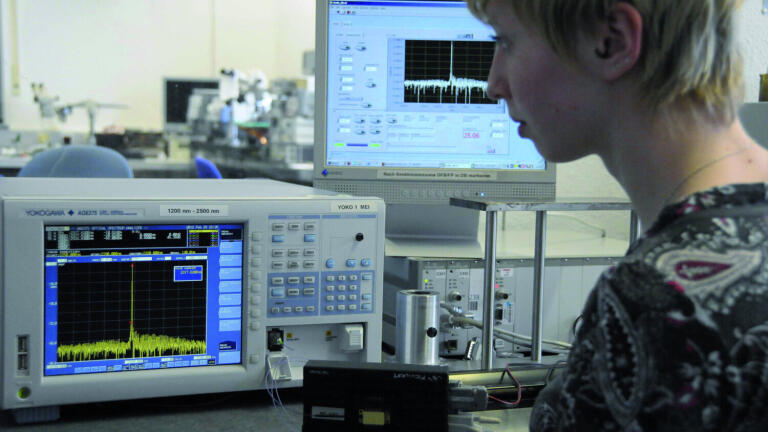
To verify the high spectral quality of the lasers, nanoplus uses an AQ6375 optical spectrum analyser from Yokogawa. This instrument offers the great advantage that its accessible spectral range extends well beyond typical wavelengths for telecommunications
With the AQ6375, the individual Fabry-Pérot laser modes can be clearly resolved. In addition, the high dynamic range enables the demonstration of single-mode laser operation with a side-mode suppression ratio of more than 50 dB. The detection of trace gases with concentrations of less than one part per billion in a gas mixture can be achieved with these high-quality DFB lasers.
nanoplus uses a fully automated test setup using the GPIB interface of the AQ6375. Despite the relatively complex measurement process, the test setup allows for a quick determination of the lasers’ tuning properties at different chip temperatures and operating currents. The lasers are tested in the range from 1200 to 2400 nm before they are supplied to the customers, according to
their applications.



.jpg)
-(2).jpg)