Laboratory products
Quantification and Characterisation of Carbon Nanotubes in Complex Matrices
Jun 19 2017
Postnova Analytics has published an application note that describes a new method to characterise and quantify Multi-Walled Carbon Nanotubes (MWCNTs) in soil samples using Asymmetrical Flow Field-Flow Fractionation coupled with MALS detection (AF4-MALS).
Effective methods to characterise and quantify MWCNTs from soil samples are rare. Quantiï¬cation, depending on the method used, may be biased by soot particles commonly found in soils and sediments. Differentiating between MWCNTs and soot particles is a big challenge as they are physically and chemically very similar.
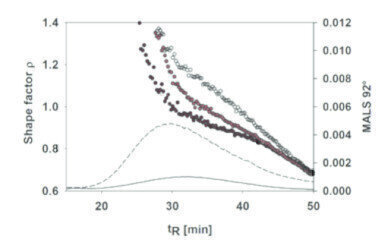
The new application note describes an investigation into how shape could be used as a contrasting parameter for the detection of MWCNTs in pure soot or even soil. In this work the researchers evaluated a shape factor ρ, derived from AF4-MALS measurements, for its capabilities to detect MWCNTs in such matrices.
The Postnova AF2000 Multiflow platform employed in this research uses a unique crossflow field design in which samples are separated by their dynamic diffusion on the basis of molar mass or particle size. Because of this design and the absence of any stationary phase, field-flow fractionation on the AF2000 Multiflow can be performed without exerting shear forces and stress on the molecules being separated.
The AF2000 can be run with different eluents, wide ranging temperature conditions and is widely proven to be the perfect system for running AF4 experiments. Consequently the AF2000 Multiflow is an ideal platform for the characterisation of nanoparticles in complex matrices.
For determination of the hydrodynamic radius (rh) of the MWCNTs in soot and soil samples the researchers used retention time calibration with different certiï¬ed latex standards. The radius of gyration (rg) was determined using a PN3621 21-angle MALS detector. The application note describes how generation of a shape factor ρ from rg and rh values over time enables differentiation of MWCNTs and soot particles.
Data is shown that demonstrates how shape factor increment is dependent on the ratio between MWCNTs and soot in a mixture. The researchers conclude that soil particles extracted by the described method are contrasting to MWCNTs in terms of ρ, allowing speciï¬c detection of MWCNTs in these complex matrices.
For a copy of this application note please contact Postnova Analytics.


Digital Edition
Lab Asia Dec 2025
December 2025
Chromatography Articles- Cutting-edge sample preparation tools help laboratories to stay ahead of the curveMass Spectrometry & Spectroscopy Articles- Unlocking the complexity of metabolomics: Pushi...
View all digital editions









Events
Jan 21 2026 Tokyo, Japan
Jan 28 2026 Tokyo, Japan
Jan 29 2026 New Delhi, India
Feb 07 2026 Boston, MA, USA
Asia Pharma Expo/Asia Lab Expo
Feb 12 2026 Dhaka, Bangladesh




