Laboratory products
The NanoChemistry group at the Department of Chemistry at DTU in Kongens Lyngby near Copenhagen, is led by Professor Jens Ulstrup.
Chemistry at the nanoscale deals with the observation and manipulation of Nature's tiniest chemical building blocks, and with the design and exploitation of new properties that arise from nanoscale objects. The NanoChemistrty group at DTU Chemistry uses new and untraditional technologies, which has helped us to open a whole new world of ‘ultra-small’ chemical and physicochemical systems of great importance for future technology. One of the current projects dealing with nanoparticles in solution is the SAMENS project.
The main objective of NanoChemistry's SAMENS project (saccharide-based approach to metallic nanostructure synthesis) is to develop methods for the preparation of novel exciting nanostructures. These include very small, metallic and metal oxide nanoparticles, core-shell hetero-nanostructures of metals and metal oxides and highly anisotropic nanostructures. These are thoroughly characterised by a variety of methods and applied in electrochemistry and electrocatalysis. The research is built on a strong ‘green’ foundation with constant efforts also
within nanotoxicology. The properties of the nanostructures depend strongly on their size and shape, so it is critical that we have precise knowledge about these parameters.
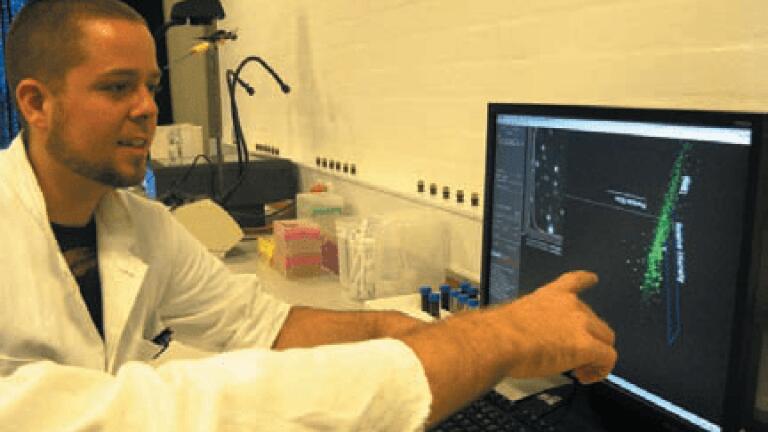
Several techniques for size and shape characterisation have been used in the project. These include TEM, AFM, STM, UV-Vis, SEM and Zetasizing. Most recently, a NanoSight system providing particle-byparticle nanoparticle tracking analysis, NTA, was acquired.
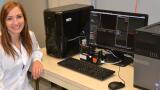
The leading user, Christian Engelbrekt from the NanoChemistry group at DTU Chemistry, described his thoughts on using the system for his research: "From my experience, NTA is superior to the majority of nanoparticle characterisation techniques and complementary to others. Compared to other light-scattering techniques in solution, the NTA user is much closer to the raw data. This provides a strong basis for analysis and interpretation of the results. This is especially important when working with hybrid and anisotropic nanostructures where very careful data analysis is needed. The other techniques are all based on dried or immobilised samples that introduces other challenges regarding interpretation. We furthermore often look at coated nanostructures and with NTA we can ‘see’ the overall size including the coating layer, which is not visible in TEM. And another advantage is that NTA is really fast and inexpensive to run."




.jpg)
-(2).jpg)