Laboratory products
Linkam Scientific Instruments report on the use of their stages in the study of nano-structures at the Cronin lab, University of Southern California, in the USA.
The Cronin lab is working on pioneering new technologies which could revolutionise solar energy storage and via a process known as plasmonic catalysis potentially allow us to use solar energy even when the sun isn't shining.
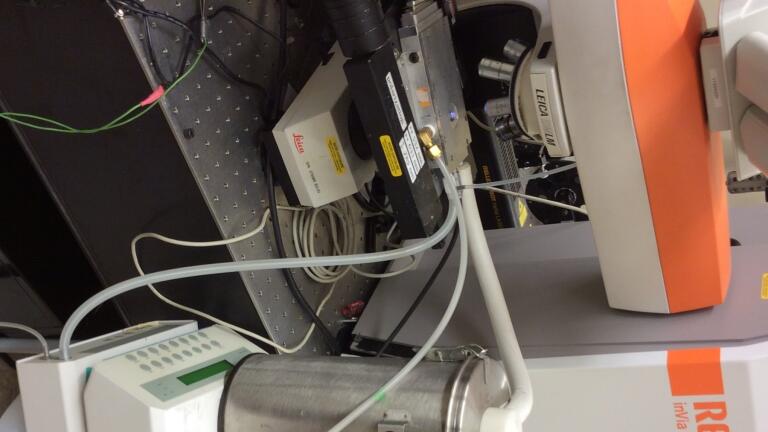
PhD student, Miss Shermin Arab, and her colleagues at the Cronin Lab are currently focusing their studies on the fabrication and transport study of numerous nano-structures. The team has used a Linkam stage to carry out optoelectronic research on these tiny structures in order to characterise them.
The two main optoelectrical characterisation methods that have been used in this research are photoluminescence (PL) and photo I-V measurements. These measurements require very stable temperature control and it is here that the Linkam stage has proved invaluable to Miss Arab. She says: "In order to reduce the noise, improve the quantum efficiency and be able to observe excitonic behaviour, these measurements are made at low temperatures. Our measurements are usually performed at 77K (-196 °C). We use the Linkam stage and liquid nitrogen to cool down the sample. The Linkam setup also allows us to perform a temperature-dependent study on the samples; where, we vary the temperature from room temperature to 77K and perform the measurements (PL or I-V) at specific temperature points."
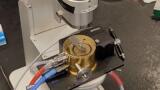
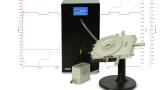
The team used a Linkam THMS600 stage to illuminate the sample and perform low temperature, light dependent measurements such as the two mentioned above. Photoluminescence is used in their lab to illuminate samples with a desired laser and then collect and analyse the emitted light after photon absorption. This measurement is especially important in finding out the crystalline quality of the GaAs nanostructures which has a huge effect on their efficiency.
Continuing, Miss Arab said, "As we move into an era where nano-structures are going to play a vital role in [take out all of] our everyday lives, research and characterisation of such materials will prove influential and allow us to optimise and tailor them to suit our needs."
CMS
Linkam Scientific Instruments
Ricky Patel



.jpg)
-(2).jpg)