Laboratory products
Introduction
PAHs are hazardous compounds found in petroleum and emissions from fossil fuel consumption. Physically, PAHs are neutral, nonpolar organic molecules that comprise two or more benzene rings arranged in various configurations. Members of this class of compounds have been identified as exhibiting toxic and hazardous properties, and for this reason the U.S. Environmental Protection Agency has included 16 PAHs on its list of priority pollutants to monitor in water and waste.
Analytically, PAHs present challenges for testing labs. Their volatile nature can make them problematic to extract without loss using manual methods. This is especially true for the evaporation/concentration of sample extracts.
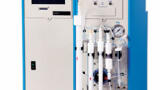
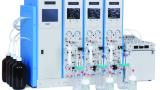
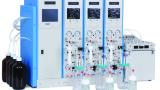
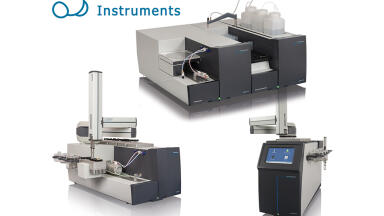
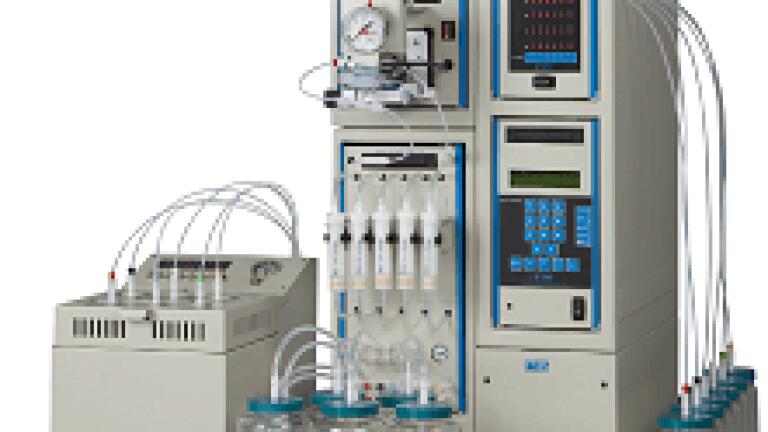
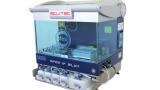
The following procedure utilizes the FMS PowerPrep™ SPE extraction system in combination with the PowerVap™ concen-trator (Figure 1) to extract PAHs from drinking water.
Instrumentation
Consumables
Procedure
PowerPrep SPE
1. Cartridges conditioned with 10 mL MeOH
2. Cartridges conditioned with 15 mL H2O
3. Samples loaded across cartridges at ~75mL/min
4. Sample bottles rinsed with H2O; Rinse loaded across cartridges.
5. Cartridges dried with N2 for 1 minute each.
6. Cartridges eluted with 10 mL Methylene Chloride.
7. Cartridges eluted with 5 mL Methylene Chloride.
8. Elution nitrogen purged directly into FMS PowerVap for concentration.
Total Time ~55 minutes
PowerVap
1. Preheat temp: 20 minutes at 40 °C
2. Sensor mode / temp: 40 °C
3. Nitrogen Pressure: 10 PSI
Results
Table 1: Results for five, 1 liter replicates spiked
at 50 ppb.
| Mean | STD | |
| Compound | Rec. | DEV |
| Naphthalene | 86.60% | 4.60% |
| 2-Methylnaphthalene | 88.20% | 3.30% |
| 1-Methylnaphthalene | 83.40% | 4.30% |
| Acenaphthylene | 81.70% | 4.80% |
| Acenaphthene | 92.30% | 6.80% |
| Fluorene | 79.40% | 5.10% |
| Phenanthrene | 87.00% | 3.00% |
| Anthracene | 81.40% | 2.80% |
| Fluoranthene | 93.50% | 2.40% |
| Pyrene | 100.80% | 3.20% |
| Benzo[a]anthracene | 88.30% | 5.10% |
| Chrysene | 93.60% | 6.60% |
| Benzo[b]fluoranthene | 85.50% | 7.00% |
| Benzo[k]fluoranthene | 91.80% | 3.90% |
| Benzo[a]pyrene | 90.50% | 5.10% |
| Indeno[1,2,3-cd]pyrene | 88.90% | 4.00% |
| Dibenzo[a,h]anthracene | 92.30% | 5.20% |
| Benzo[g,h,i]perylene | 88.10% | 3.70% |
| Nitrobenzene-D5 (Surr) | 93.60% | 6.10% |
| 2-Fluorobiphenyl (Surr) | 96.40% | 4.90% |
| p-Terphenyl-d14 (surr) | 81.70% | 5.20% |
Conclusions
Results reported from the PowerPrep™ SPE and PowerVap™ Direct-to-Vial Concentration system (Table 1) show high levels of precision and accuracy for the parallel extraction and concentration of PAHs using the FMS integrated Sample-to- Vial systems. With expanded modules, the PowerPrep SPE system enables the lab to simultaneously extract full batches of sample (up to 30) hands free. Compared to manual extraction processes, this auto-mated technique frees up chemists to focus on increasing sample throughput. The addition of direct to GC vial concen-tration tubes eliminates the need to manually transfer extract from the concentration tubes to the vials and reduces operator error.


.jpg)
-(2).jpg)