

Laboratory products
Quality Control of Rolling Oils through Automated Distillation Analysis
Nov 05 2025
Ensuring consistent product quality through rolling oil monitoring
In the metalworking industry, the quality and composition of rolling oils play a decisive role in ensuring stable production, protecting machinery, and achieving precise surface finishes. Conventional cold-rolling oil formulations used in thin-sheet manufacturing typically consist of a petroleum-derived base fluid – comprising various long-chain hydrocarbons – combined with one or more additives. These additives, such as fatty alcohols, fatty acids, and their esters, are incorporated to enhance the base oil’s oxidative stability and frictional properties.
Over time, higher-boiling components can accumulate in the rolling oil. This can impair lubrication efficiency and product quality, which is especially critical for highly demanding applications in the food and pharmaceutical industries. Continuous monitoring of rolling oils is therefore essential for maintaining consistent process performance and product reliability.
Distillation analysis reveals rolling oil condition and composition
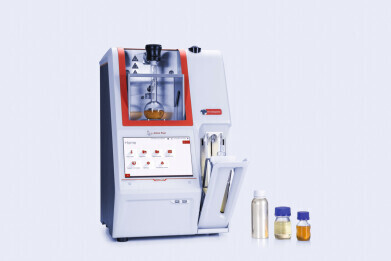
Atmospheric distillation analysis provides a fast and reliable way to characterize rolling oils and detect compositional changes. Using the Anton Paar Diana 700 automatic distillation analyzer, three typical samples used in the cold rolling of aluminum foil were tested according to ASTM standard D86: a base oil, a freshly rectified base oil with additives, and a heavily used base oil with additives. Using a default program, Diana 700 accurately reproduced the manufacturer’s specification for the base oil and for the freshly rectified rolling oil with excellent repeatability.
For the heavily used rolling oil, analysis using the same program led to a noticeable boiling delay, resulting in unstable distillation rates and temperature readings at the beginning of the test. However, by applying a modified heating program, stable distillation behavior could be achieved even for this challenging sample. Elevated initial and final boiling points and residue levels in the used oil suggested the accumulation of substantial amounts of higher-boiling impurities due to pronounced thermal decomposition of the rolling oil.
Together, these findings demonstrate that the boiling characteristics are indicative of the oil’s composition and condition. Regular monitoring through distillation analysis can therefore help define appropriate rectification intervals and reduce the risk of product contamination. For an in-depth look at the distillation analysis results, refer to our application report available on our website.
A reliable, automated solution for rolling oil quality control
With its intuitive operation, Diana 700 delivers a dependable solution for rolling oil quality control, ensuring consistent performance and superior product quality throughout production. It simplifies daily laboratory work through full automation of heating control, temperature recording, and volume measurement. Compared to manual distillation, it offers higher safety, precision, and throughput – key advantages for routine quality control in lubricant manufacturing and metal-processing environments.


Digital Edition
Lab Asia Dec 2025
December 2025
Chromatography Articles- Cutting-edge sample preparation tools help laboratories to stay ahead of the curveMass Spectrometry & Spectroscopy Articles- Unlocking the complexity of metabolomics: Pushi...
View all digital editions









Events
Jan 21 2026 Tokyo, Japan
Jan 28 2026 Tokyo, Japan
Jan 29 2026 New Delhi, India
Feb 07 2026 Boston, MA, USA
Asia Pharma Expo/Asia Lab Expo
Feb 12 2026 Dhaka, Bangladesh




