Pipettes
Iontronic micropipettes developed for precision in dynamic ionic modulation of neuronal and astrocytic activity
A novel design of micropipette has been developed by researchers at Linköping University, Sweden, that can deliver an ion to an individual neuron. This can now be achieved without disturbing the extracellular milieu – the environment around a cell – and allow for control of concentration levels of different ions.
The advances this give to the field should mean that individual braincells will be able to be studied and also examination of how cells work together. The technology could also have treatment applications.
“In the long term, this technology could be used to treat neurological diseases such as epilepsy with extremely high precision,” says Professor Daniel Simon at Linköping University (LiU).
The human brain has up to 100 billion neurons with around the same number of other cells in the brain that support neuronal functions – nutrition, oxygenation and healing. These are glial cells and can be further divided into subgroups. In between cells is the extracellular milieu which is a space that contains a fluid.
Differences between the milieu – on this inside and outside of cells – is important for cell function with one important aspect being the transportation of different ion types between the milieus, ie., neurons are activated when there are changes in the concentration of potassium ions.
It is well understood that a change in the whole extracellular milieu affects how neurons behave and so activity in the brain. However, so far, it has not been known how local changes in ion concentration affect individual neurons and glial cells.
Previous attempts to change the extracellular milieu have primarily involved pumping in some form of liquid but this disturbs the delicate biochemical balance. It then becomes difficult to know if it is the substances in the fluid, changes in pressure or the movement in the extracellular fluid that has led to the brain activity.
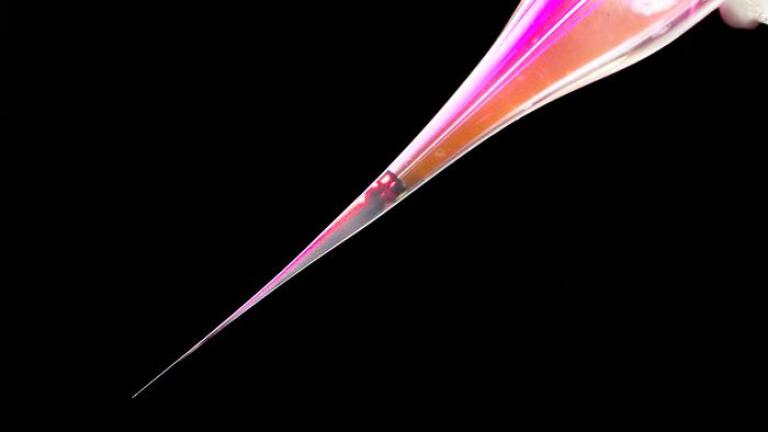
Researchers at the Laboratory of Organic Electronics (LOE) at LiU have developed a micropipette five times smaller than a neuron, measuring only 2 micrometres (mm) in diameter, to address this problem. By comparison, a human hair measures 50 mm and a neuron itself about 10 mm in diameter.
Using this so-called iontonic micropipette, the researchers can add only ions, such as potassium and sodium, to the extracellular milieu to see how this affects the neurons. Glial cell – specifically astrocyte – activity can also be measured.
“Glial cells are the cells that make up the other – chemical – half of the brain, which we don’t know much about because there has been no way to precisely activate those cells, as they don’t respond to electrical stimulation.
“But both neurons and glial cells can be stimulated chemically,” says Assistant Professor Theresia Arbring Sjöström of LOE, LiU.
The experiments were conducted on slices of hippocampus brain tissue from mice.
“The neurons didn’t respond as quickly to the change in ion concentration as we had initially expected. However, the astrocytes responded directly and very dynamically. Only when these were ‘saturated’ were the nerve cells activated.
“This highlighted the fine-tuned dynamics between different types of cells in the brain in a way that other technologies haven’t managed to do,” said Arbring Sjöström.
Simply put, the pipette is manufactured by heating up a glass tube and pulling it to the breaking point which produces a very thin and tapered tip. This type of micropipette is usually used in neuroscience to create and measure electrical activity in the brain. The LiU researchers’ iontronic micropipette has a tip filled with a specially adapted ion-exchange membrane, which makes it possible to create activity by chemical means. Other than that, it looks identical to the traditional micropipette and is controlled in a similar way.
“The advantage is that tens of thousands of people around the world are familiar with this tool and know how to handle it. This will make it useful,” said Simon.
For further reading please visit: 10.1002/smll.202410906

.jpg)
-(2).jpg)