Raman spectroscopy
Raman Materials Analysis Helps Researchers Understand the Use of Colour in Roman Sculpture
Dec 06 2017
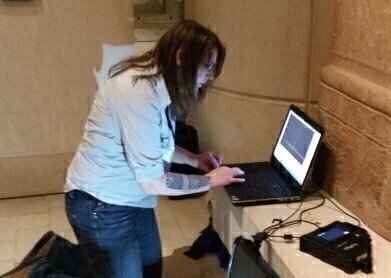
Dr Louisa Campbell is researching Paints and Pigments In the Past (PPIP) in her role as Postdoctoral Fellow in Archaeology at the University of Glasgow, a project part-funded by Historic Environment Scotland's Archaeology Programme.
The project team aims to analyse and identify the compounds in pigments used on Roman sculpture, with a focus on distance stones from the Antonine Wall. Most of the examples available were discovered between the 17th and 19th centuries, and are on display at the Hunterian Museum at the University of Glasgow. The central aim of the project is to identify the pigments originally applied and then to recreate an authentic palette of colours to enable them to be digitally reconstructed.
Dr Campbell had previously used p-XRF technology for her analysis which began with sampling of a distance slab that had been repainted in 16th century and installed into a dramatic setting in Dunnottar Castle, Stonehaven. She is supporting the work with Raman technology to draw comparison between the data and to reach a better understanding of the chemical and mineral compounds which the original pigments comprised.
She has just completed a period of intensive data gathering using a SciAps Inspector Raman® handheld materials identification system on short-term loan from Analytik UK, SciAps' official distributors in the United Kingdom and Ireland. This unique instrument enables one micron Raman material discrimination which can increase the number of samples identified by eliminating unwanted samples and background fluorescence.
Patricia Weeks, World Heritage Site Coordinator for Historic Environment Scotland said: “This is a great example of an archaeological project using new technology to provide an insight into the use of colour in the Roman World. It helps us to reconstruct, and better understand, what these monuments would have looked like when they were first displayed. The results of Louisa's work will allow us to consider the wide range of colours that may once have decorate these stones, and will help to inform digital and physical reconstructions of carved stones from the Antoine Wall as part of a wider Heritage Lottery Fund bid.”
Dr Campbell expects to have developed some initial conclusions by early 2018 and will publish her findings for peer review once complete.

Digital Edition
Lab Asia Dec 2025
December 2025
Chromatography Articles- Cutting-edge sample preparation tools help laboratories to stay ahead of the curveMass Spectrometry & Spectroscopy Articles- Unlocking the complexity of metabolomics: Pushi...
View all digital editions









Events
Jan 21 2026 Tokyo, Japan
Jan 28 2026 Tokyo, Japan
Jan 29 2026 New Delhi, India
Feb 07 2026 Boston, MA, USA
Asia Pharma Expo/Asia Lab Expo
Feb 12 2026 Dhaka, Bangladesh




