-
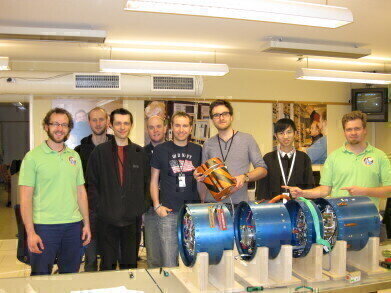 Experiment shortly before launch in March 2012 (from left to right: Mark Fittock (payload manager), Jerker Skogby, Adam Wujek, Fredrik Rogberg, Thomas Sinn, Malcolm McRobb, Junyi Wang and Mark Uitendaal (payload manager)
 -
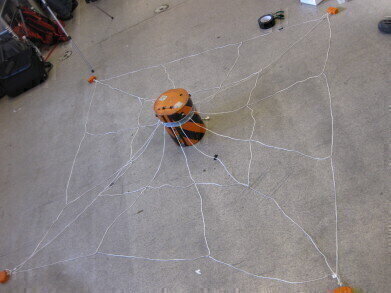 Suaineadh platform
News
Students Recover Space Experiment from Arctic Circle
Mar 28 2014
A team of students has recovered crucial data from an innovative experiment that could reduce the cost of space construction – with help from Swedish hunters.
Science and engineering students from the Universities of Strathclyde and Glasgow along with Stockholm’s Royal Institute of Technology have been developing a smart space foundation that will support larger structures, such as telescopes or telecommunications antennae.
The web-like platform, known as Suaineadh – or ‘twisting’ in Scots Gaelic, was launched on-board the sounding rocket REXUS12 from the Swedish space centre Esrange in March 2012; however the section containing recorded data could not be found after re-entry despite a 10-day recovery mission in Northern Sweden, where the students faced freezing arctic conditions and were forced to concede defeat – until its discovery, with data intact, by Swedish hunters 18 months later.
Delighted that the huge amount of work behind the project, involving years of collaboration with partners had not been in vain, Thomas Sinn, Project Manager for the experiment at the University of Strathclyde, said: "The cameras attached to the central section have provided almost 1,000 images that have let us see the ejection of the web and show the deployment – held in tension by the centrifugal forces – resulting in an interesting deployment sequence. This is a significant step forward and will allow future projects to improve the concept and help make ambitious space projects involving large structures more technically feasible."
Malcolm McRobb, of the University of Glasgow, added: "The purpose behind the Suaineadh experiment was to provide a proof-of-concept that is scalable in design. We imagine that such a device could one day be adapted to deploy much larger structures in space, ranging from huge antenna arrays, solar isolators, solar panels, solar sails, and even scaffolding structures from which to build other structures from whilst in orbit about the Earth. The possibilities are as endless as they are vast, and that is the reason why Suaineadh was such an exciting project to work on as a university student."
Researchers at the three institutions are now working on the post-processing of the collected data to validate deployment simulations. Such simulations can be used to develop space structures faster, without the need for expensive testing in space.

Digital Edition
Lab Asia Dec 2025
December 2025
Chromatography Articles- Cutting-edge sample preparation tools help laboratories to stay ahead of the curveMass Spectrometry & Spectroscopy Articles- Unlocking the complexity of metabolomics: Pushi...
View all digital editions







Events
Jan 21 2026 Tokyo, Japan
Jan 28 2026 Tokyo, Japan
Jan 29 2026 New Delhi, India
Feb 07 2026 Boston, MA, USA
Asia Pharma Expo/Asia Lab Expo
Feb 12 2026 Dhaka, Bangladesh




