-
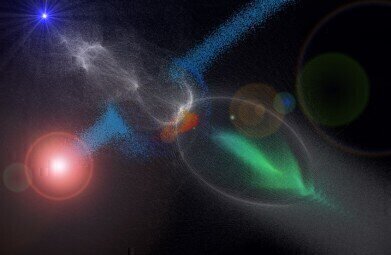 Illustration, based on simulations, of the Trojan horse technique for the production of high-energy electron beams. A laser beam (red, at left) strips electrons (blue dots) off of helium atoms. Some of the freed electrons (red dots) get accelerated inside a plasma bubble (white elliptical shape) created by an electron beam (green). (Credit: Thomas Heinemann/University of Strathclyde)
News
Project could Inspire Next Generation X-ray Lasers and Particle Accelerators
Oct 02 2019
A ground breaking technique that could produce an electron beam up to 10,000 times brighter than the most powerful beams today, has been developed by researchers from the UK and US. The findings* could be particularly applicable for use in the next generation of more compact, more powerful particle accelerators, enhancing scientific applications.
Led by the University of Strathclyde’s Professor Bernhard Hidding, who is also a member of the STFC’s Cockcroft Institute, the E-21-: Trojan Horse experiment which was carried out at the U.S Department of Energy’s Stanford Linear Accelerator Center (SLAC) in California, involved releasing electrons from neutral atoms inside plasma, to produce a potentially much brighter, plasma-based electron source. Professor Hidding said: “Our experiment demonstrates the feasibility of one of the most promising methods for future electron sources and could push the boundaries of today’s technology by orders of magnitude.”
The researchers also developed several auxiliary techniques, which would improve the quality and stability of their output beams and to harness the technique for applications.
In a forward-looking, complementary project funded by STFC, Professor Hidding and colleagues from UK and US are already exploring the benefits to be expected from ultrabright and ultrashort electron beams for X-ray free electron lasers and other light sources at CLARA, a particle accelerator designed to develop, test and advance new technologies for the next generation of particle accelerators and free-electron-lasers, at STFC’s Daresbury Laboratory. In conjunction with further R&D at SLAC’s FACET-II facility, the Scottish Centre for the Application of Plasma-based Accelerators (SCAPA) and the Central Laser Facility (CLF), these ultrabright beams may eventually allow production of X-ray pulses short and bright enough to allow observation of electronic motion inside atoms and molecules on their natural timescale.
Fuller details can be found at www.strath.ac.uk
*Published in Nature Physics
Digital Edition
Lab Asia Dec 2025
December 2025
Chromatography Articles- Cutting-edge sample preparation tools help laboratories to stay ahead of the curveMass Spectrometry & Spectroscopy Articles- Unlocking the complexity of metabolomics: Pushi...
View all digital editions








Events
Jan 21 2026 Tokyo, Japan
Jan 28 2026 Tokyo, Japan
Jan 29 2026 New Delhi, India
Feb 07 2026 Boston, MA, USA
Asia Pharma Expo/Asia Lab Expo
Feb 12 2026 Dhaka, Bangladesh




