-
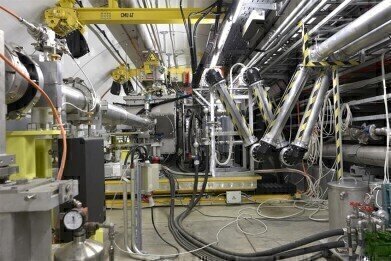 Test bench of the first two prototype crab cavities in the Super Proton Synchrotron (SPS) accelerator. The cryomodule containing the cavities is installed on a mobile table that allows it to be moved into the beam line as needed. (Credit: M. Brice/CERN)
News
Breakthrough will Underpin next High Luminosity Platform at LHC
Jun 15 2018
Engineers and scientists, working with colleagues at CERN, have made a major contribution to a technology breakthrough that revolutionises the world of high energy particle physics. Supported by STFC and led by Lancaster University and the University of Manchester and involving the Cockcroft Institute, the UK team worked alongside experts from around the world to successfully test a new technology called ‘crab cavities’ and rotate a beam of protons for the first time. The test took place on 23 May using a beam from CERN’s Super Proton Synchrotron (SPS) accelerator and showed that bunches of protons could be tilted using these superconducting transverse radio-frequency cavities.
The Crab-Cavity technology revolutionises the world of high energy particle physics as the implementation of crab-cavities is critical to the delivery of the next level of energy and luminosity of the LHC, paving the way to increasing our understanding of the Higgs Boson(s) and ultimately the Universe. The UK has led the world in the development and construction of this technology and is working hard to make HL-LHC a reality.
STFC’s Executive Director of Programmes Professor Grahame Blair said: "This is a fantastic result for CERN and for all the collaborators involved. I am particularly happy that UK university teams, working with staff at STFC national laboratories and with the international community, have made such a key contribution. This demonstrates the value of our world class university-based programme in accelerator physics working alongside our detector and analysis teams in mapping out fully the structure of nature at the LHC energy scale; every bit of luminosity will count in this endeavour."
The HL-LHC, which will be commissioned after 2025, will increase the luminosity of the LHC by a factor of five to ten, significantly increasing the number of collisions over a given time period allowing researchers to observe rare processes that occur beyond the LHC’s present sensitivity level.
The team from the University of Manchester were involved in the beam dynamics modelling and understanding how to measure the crabbing, while colleagues from Lancaster/Cockcroft Institute were involved in and in many cases led, the design of a number of the subsystems and in all phases of testing from sub-systems to the final test. The main STFC contribution was in developing the cryomodule that encloses the crab cavities and keeps them cool with superfluid liquid helium.

Digital Edition
Lab Asia Dec 2025
December 2025
Chromatography Articles- Cutting-edge sample preparation tools help laboratories to stay ahead of the curveMass Spectrometry & Spectroscopy Articles- Unlocking the complexity of metabolomics: Pushi...
View all digital editions







Events
Jan 21 2026 Tokyo, Japan
Jan 28 2026 Tokyo, Japan
Jan 29 2026 New Delhi, India
Feb 07 2026 Boston, MA, USA
Asia Pharma Expo/Asia Lab Expo
Feb 12 2026 Dhaka, Bangladesh




