-
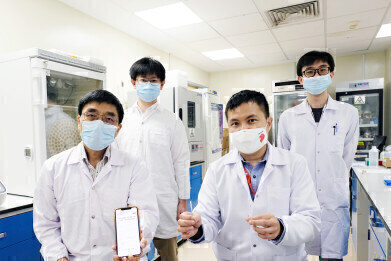 Pictured left to right: NTU School of Computer Science and Engineering’s Professor Lin Weisi and PhD student Hou Jingwen, NTU School of Chemical and Biomedical Engineering’s Assoc Professor Tan Meng How and project officer Ooi Kean Hean.
 -
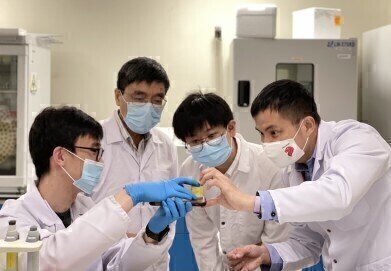 Pic 2: project officer Ooi Kean Hean, Professor Lin Weisi, PhD student Hou Jingwen, Associate Professor Tan Meng How
News
Robust Tool Tracks Evolved Forms of Virus
Mar 30 2021
A test capable of detecting mutated forms of SARS-CoV-2 which lead to development of the COVID -19 virus, including some that have spread widely in the United Kingdom, South Africa and Brazil, has been developed by a team of scientists led by Nanyang Technological University, Singapore (NTU Singapore).
The VaNGuard (Variant Nucleotide Guard) test uses CRISPR gene-editing to alter DNA sequences and modify gene function in human cells under lab conditions and more recently, in diagnostic applications.
With the ability of the virus to evolve over time, the genetic sequence variations in new strains may impede the ability of some diagnostic tests to detect the virus, said NTU Associate Professor Tan Meng How, whose team includes researchers from the National University Health System and the Agency for Science, Technology and Research, Singapore (A*STAR).
The VaNGuard test, which can be used on patient samples in a clinical setting without the need for RNA purification is said to yield results in 30 minutes, about a third of the time required for the standard PCR method.
Associate Professor Tan, who is from NTU’s School of Chemical and Biomedical Engineering, said: “Viruses are very smart. They can mutate, edit, or shuffle their genetic material, meaning diagnostic tests may fail to catch them. Hence, we spent considerable effort developing a robust and sensitive test that can catch the viruses even when they change their genetic sequences. In addition, frequent testing is essential for helping to break the transmission of viruses within populations, so we have developed our tests to be rapid and affordable, making them deployable in resource-poor settings.”
The research team, plans to further refine their diagnostic kit, obtain regulatory approval from relevant authorities and commercialise their test in partnership with diagnostic companies.
Research Paper ‘An engineered CRISPR-Cas12a variant and DNA-RNA hybrid guides2 enable robust and rapid COVID-19 testing’ published in Nature Communications. 12, 1739 (2021) DOI: 10.1038/s41467-021-21996-6
Further information online



Digital Edition
Lab Asia Dec 2025
December 2025
Chromatography Articles- Cutting-edge sample preparation tools help laboratories to stay ahead of the curveMass Spectrometry & Spectroscopy Articles- Unlocking the complexity of metabolomics: Pushi...
View all digital editions










Events
Jan 21 2026 Tokyo, Japan
Jan 28 2026 Tokyo, Japan
Jan 29 2026 New Delhi, India
Feb 07 2026 Boston, MA, USA
Asia Pharma Expo/Asia Lab Expo
Feb 12 2026 Dhaka, Bangladesh




