-
-
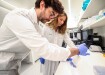
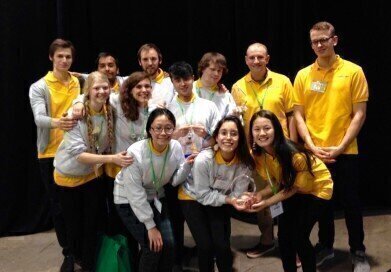 ICL students working on the project
News
Students Brew Up Modified Bacteria
Jun 21 2016
A team of scientists and undergraduates at Imperial College London (ICL) have developed a way of modifying bacteria normally found in fermented tea so they can customise cellulose production.
Harvested in huge amounts from trees and plants to make materials like paper and cardboard, cellulose is also produced in a very strong and pure form by some harmless bacteria, which can be incorporated into products such as materials for headphones, or ingredients in cosmetics.
The researchers at ICL have developed a set of DNA tools to control and engineer a strain of bacteria - normally found in a fermented green tea drink called kombucha tea - to produce modified bacterial cellulose on command. This technique, which also enables the team to “weave” proteins and other biomolecules into the fabric of the bacterial cellulose as it grows, makes it applicable to other applications.
Some team members are already pursuing commercially the development of improved water filters patterned with proteins that can remove specific contaminants from the water. Another application could see the material being developed as a fabric with in-built living sensing. The team say the cellulose can be made to produce proteins that detect chemicals like metal and biological toxins and then change the material colour in response as a warning.
Student project lead Michael Florea, who recently graduated from Imperial’s Department of Life of Sciences, said: “What makes this approach so promising is that we’ve shown that bacterial cellulose production can be genetically controlled, which means that we grow material with different shapes, patterns and sizes. We can also weave in other proteins and biomolecules, which has never been possible before.”
Dr Tom Ellis, who is also a co-author from Imperial’s Department of Bioengineering, said: “The real big achievement here is that this was a project from a team of undergraduates that has now become a major research paper. Bacterial cellulose is a remarkable material that is malleable, safe and strong. We believe the tools developed by the students will take manufacturing of this product into the twenty first century.”
The research was published in journal Proceedings of the National Academy of Sciences.


Digital Edition
Lab Asia Dec 2025
December 2025
Chromatography Articles- Cutting-edge sample preparation tools help laboratories to stay ahead of the curveMass Spectrometry & Spectroscopy Articles- Unlocking the complexity of metabolomics: Pushi...
View all digital editions








Events
Jan 21 2026 Tokyo, Japan
Jan 28 2026 Tokyo, Japan
Jan 29 2026 New Delhi, India
Feb 07 2026 Boston, MA, USA
Asia Pharma Expo/Asia Lab Expo
Feb 12 2026 Dhaka, Bangladesh




