Mills and grinders
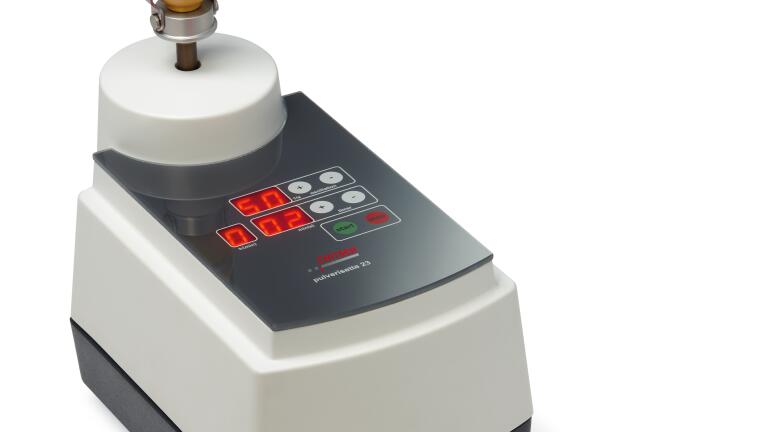
With the ultra-compact P-23, Fritsch has developed a vibratory mill especially for the fine grinding of very small quantities. A footprint of just 20 x 30 cm and a weight of 7 kg make the device particularly space-saving and lightweight. This makes the P-23 ideal for use in gloveboxes, for example. To ensure optimum working conditions here, Fritsch has now expanded its portfolio to include the P-23 glovebox ready version, which is specially tailored to this area of application.
Gloveboxes create a reaction-inhibiting (or inert) working environment with controlled pressure and atmospheric conditions. They are used for the comminution and analysis of oxygen-sensitive substances such as certain fats and vitamins in the food sector or metals, for example in battery research. The size of the glovebox is usually determined by the size of the equipment required for the work, which is fed into the box through pre-chambers in order to maintain the existing atmosphere. As a rule, the larger the glovebox, the higher the investment. The extremely compact P-23 vibratory mill is therefore particularly suitable for use in gloveboxes. The new P-23 glovebox ready, which has been optimised for this area, has several new features. It is equipped with a glovebox-optimised motor to easily withstand the alternative atmospheric conditions that arise when using argon, for example. The mill also has a membrane keypad, which makes it easier to operate with gloves than the glass keypad on the standard P-23. It also has been extended to include a USB interface, which enables the mill to be read out for servicing purposes. These features open many areas of application for the P-23 glovebox ready, e.g. in the food, animal feed and pharmaceutical industries as well as in battery research and mechanochemistry.
The P-23 can be used to grind medium-hard, brittle or moist samples either wet, dry or cryogenically. The vibratory mill grinds the samples by impact and friction between the grinding balls and the inner wall of the grinding bowl. For this purpose, the bowl is placed in a vertical oscillation movement with 900 to 3,000 oscillations per minute and an amplitude of 9 mm. To make optimum use of the grinding principle of a ball mill, Fritsch has developed a grinding bowl with spherical inner walls for the P-23.
This increases the effectiveness of the grinding, facilitates recovery and simplifies cleaning. In addition, the spherical grinding bowls can be assembled very easily and quickly without screwing. The bowls and grinding balls are also available in different materials. Depending on the requirements of the material to be ground, contamination of the sample due to undesired abrasion can be avoided. Fritsch also offers grinding bowls and grinding balls made of zirconium oxide for completely metal-free grinding.
More information online


.jpg)
-(2).jpg)