Microscopy & microtechniques
Extensive Digital Imaging Features Enable Better Microscopy
Jan 28 2009
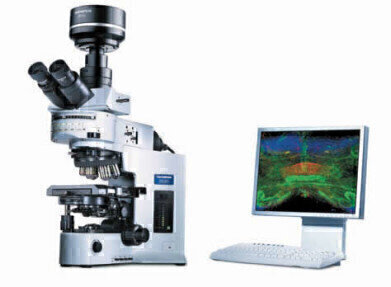
Olympus has launched the new and improved cell family range of mutually compatible imaging systems, combining excellent performance with user-friendly operation. These three software imaging programmes bring increasing numbers of capabilities to imaging systems so that each task, project or experiment can be completed using the most suitable set of tools.
cell^D is a comprehensive and reliable imaging and documentation system for life science microscopy. In conjunction with a digital camera and a microscope cell^D becomes the perfect system for microscope image acquisition, archiving and documentation. Images of unlimited depth of focus can be generated using the extended focus function either manually or via a motorised focus drive.
The cell^D software controls all necessary hardware, and contains a range of enhanced image acquisition tools, standard image processing and measurement functions. This is all
complemented by a structured database and a report generation tool.
Olympus cell^F is designed with all the features of cell^D and includes the additional benefits of speciality tools for fluorescence imaging. It is therefore designed to handle automated
processes and multi-dimensional fluorescence image manipulation. cell^F is flexible and easily adapted to suit each researcher’s fluorescence acquisition, processing, visualisation and
documentation needs. Furthermore, it includes advanced spectral unmixing algorithms to separate fluorescence image information from multiple GFP variants enabling, for instance,
GFP and YFP to be used in the same fluorescence study. What is more, predefined position masks can be used to generate images of the experiment results in multiwell-plates.
Building on cell^F, cell^P is the software solution to meet the more demanding procedures within the field of life science imaging. Complex multiple fluorescence image-analysis tasks such as ratio imaging, delta F/F measurements or kinetic evaluation are completed with ease and can be carried out automatically. It also enables time-lapse imaging, out-of-focus haze removal and advanced image visualisation. Olympus cell^P can be integrated with other software platforms via the Imaging C scripting language, which enables more efficient imaging laboratory workflows.
If needs change, they can all be upgradeable to more advanced packages in the Olympus cell imaging family.
.jpg)
-(2).jpg)

Digital Edition
Lab Asia Dec 2025
December 2025
Chromatography Articles- Cutting-edge sample preparation tools help laboratories to stay ahead of the curveMass Spectrometry & Spectroscopy Articles- Unlocking the complexity of metabolomics: Pushi...
View all digital editions










Events
Jan 21 2026 Tokyo, Japan
Jan 28 2026 Tokyo, Japan
Jan 29 2026 New Delhi, India
Feb 07 2026 Boston, MA, USA
Asia Pharma Expo/Asia Lab Expo
Feb 12 2026 Dhaka, Bangladesh




