Microscopy & microtechniques
Illinois State University use NTA in their development of Novel Bioanalytical Assays
May 24 2013
NanoSight reports on how Nanoparticle Tracking Analysis, NTA, is being used in the development of novel bioanalytical assays at Illinois State University.
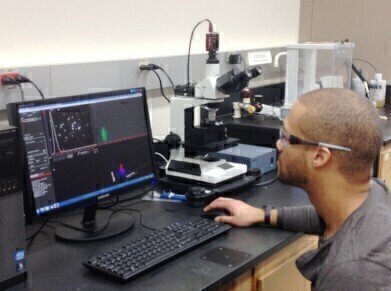
Speeding up the detection and identification of viruses is one of the areas of new research of Illinois State University Assistant Professor of Chemistry Jeremy Driskell. This has been recognised by the US Department of Defense in their recent award of a major grant. Reliable and accurate nanoparticle composition is important in such work.
Here, Dr Driskell describes how he has used various techniques.
Talking about his current work, Dr Driskell says "Our research group is focused on the development of novel bioanalytical assays which includes detection of nucleic acids, proteins, and whole viruses. While other groups aim to improve assay sensitivity or detection limits, our central focus is on reducing assay speed and complexity. We are currently using gold nanoparticles and gold filters to develop assays utilising surface-enhanced Raman spectroscopy for detection. In the process of characterising the gold nanoparticles and monitoring the modification steps required for the SERS assays, we found that particle sizing techniques such as Dynamic Light Scattering (DLS) and Nanoparticle Tracking Analysis (NTA) could also be used for assay readout. This finding and application is detailed in our recent publication in the Analyst."
Dr Driskell continued: "We began by using DLS to characterise gold nanoparticles that we modify with Raman reporter molecules and antibodies. This was a simple means of detecting particle aggregation as a result of surface modification and is more sensitive than colorimetric detection, which we found was not useful for conditions that invoked slight aggregation. When we learned of NanoSight and NTA, we compared the data to DLS. For our purposes, NTA gave a much more accurate representation of the actual particle sizes in our solutions. DLS would frequently indicate aggregation of a nanoparticle population while NTA revealed few large aggregates while the majority of the particles remained monodisperse. Ultimately we concluded it was a better technique to give us a better understanding of nanoparticle composition (aggregates compared with individual particles) in terms of absolute numbers."
.jpg)
-(2).jpg)


Digital Edition
Lab Asia Dec 2025
December 2025
Chromatography Articles- Cutting-edge sample preparation tools help laboratories to stay ahead of the curveMass Spectrometry & Spectroscopy Articles- Unlocking the complexity of metabolomics: Pushi...
View all digital editions










Events
Jan 21 2026 Tokyo, Japan
Jan 28 2026 Tokyo, Japan
Jan 29 2026 New Delhi, India
Feb 07 2026 Boston, MA, USA
Asia Pharma Expo/Asia Lab Expo
Feb 12 2026 Dhaka, Bangladesh




