Microscopy & microtechniques
Report on the use of the NanoWizard® 3 AFM system at the Hebrew University of Jerusalem
Apr 17 2015
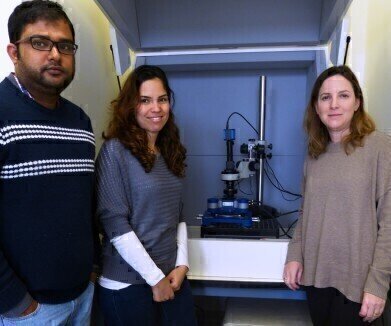
Dr Meital Reches is a senior lecturer in the Institute of Chemistry at The Hebrew University of Jerusalem. The activities in her lab focus on developing new biomolecular self-assembled systems and the study of proteins and peptides interactions with surfaces. The goals of her team are first to understand how proteins/peptides interact with inorganic surfaces. This question is very important to many areas including the design of new implants because when an implant is inserted into the body, proteins are adsorbed on its surface. These proteins will mediate the immune response towards the implant. This is also important for the synthesis of novel composite materials as sophisticated composites are formed in nature through the interactions between proteins and inorganic minerals. Moreover, if they are able to control the interaction between protein and inorganic materials, they would be able to design materials that will resist biofilm formation (antifouling materials).
Secondly, they wish to design functional peptide-based materials. Nature exploits simple building blocks to generate complex architectures through the process of self-assembly. Understanding this process is essential for areas ranging from drug discovery to materials science. Peptides, specifically, can be used as a simple system for the study of molecular self-assembly, and hold a great promise in the area of nanotechnology as they are biocompatible, versatile, and can be easily decorated with biological and chemical entities. To mimic nature and form complex architectures by self-assembly, the lab explores new strategies for the discovery of novel peptide-based nanostructures and their organisation on surfaces.
Describing her use of atomic force microscopy, Dr Reches said: “We use AFM to perform single molecule force spectroscopy measurements. We attach an amino acid, a peptide or a protein to the AFM tip and study its interaction with different inorganic substrates. In addition we use the AFM for imaging peptide assemblies. I find the system is very friendly to the user when I compare it to other AFM systems. In addition, the force spectroscopy mode is very reliable and fast.”
Dr Reches has published several papers illustrating her applications of the NanoWizard® AFM. These include ‘a study of the self-assembly of a tripeptide into a functional coating that resists fouling’ and ‘the co-assembly of aromatic dipeptides into biomolecular necklaces’.
.jpg)
-(2).jpg)
Digital Edition
Lab Asia Dec 2025
December 2025
Chromatography Articles- Cutting-edge sample preparation tools help laboratories to stay ahead of the curveMass Spectrometry & Spectroscopy Articles- Unlocking the complexity of metabolomics: Pushi...
View all digital editions









Events
Jan 21 2026 Tokyo, Japan
Jan 28 2026 Tokyo, Japan
Jan 29 2026 New Delhi, India
Feb 07 2026 Boston, MA, USA
Asia Pharma Expo/Asia Lab Expo
Feb 12 2026 Dhaka, Bangladesh




