-
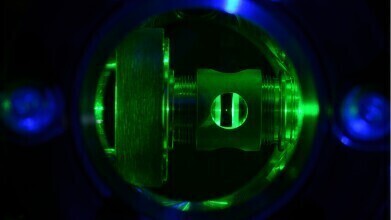 Laser cooling a levitated nanoparticle to its quantum ground state in a vacuum chamber. Credit: The University of Manchester
 -
 Dr Jayadev Vijayan. Credit: The University of Manchester
Research news
Freezing motion at the quantum limit
Aug 06 2025
An international team of researchers has cooled the spinning motion of a nanoparticle to its quantum ground state, achieving the coldest possible mechanical motion ever recorded. The advance sets a new standard in quantum optomechanics and lays the foundation for precision sensing technologies of the future.
Led by ETH Zurich and involving researchers from The University of Manchester, TU Wien, and ICFO Barcelona, the collaboration demonstrates how light, vacuum, and nanotechnology can be combined to exert quantum-level control over physical systems containing billions of atoms.
In the work [1], published in Nature Physics, a 100-nanometre glass disc was suspended using laser light in an ultra-high vacuum chamber. The researchers then used a carefully aligned optical cavity to extract energy from the disc’s rotational motion, cooling it to the lowest physically permitted level - its quantum ground state.
Dr Jayadev Vijayan, Research Fellow at The University of Manchester’s Department of Electrical and Electronic Engineering.
“This high-purity quantum state of motion gives us the best starting point to test whether objects 10,000 times heavier than current record-holders still exhibit wave-like quantum behaviour,”
Quantum systems must be cooled close to absolute zero to suppress classical motion and observe quantum effects. The technique demonstrated here overcomes that challenge for comparatively large systems, where quantum phenomena are typically washed out by thermal noise.
Professor Carlos Gonzalez-Ballestero of TU Wien explained:
“By tuning the optical cavity, the laser preferentially extracts energy from the particle’s motion. Eventually, it spins so slowly that it reaches its quantum ground state.
What makes this result especially significant is the record-breaking purity of the final quantum state - meaning that the particle's behaviour is dominated by quantum physics, not environmental noise. This level of control opens the door to practical applications, such as ultrasensitive accelerometers, navigation systems independent of GPS, and tools for geophysical exploration.
The development supports global efforts to harness quantum mechanical systems for real-world applications. Levitated nanoparticle-based sensors, built on principles demonstrated in this study, could provide a foundation for scalable, portable quantum technologies.
Dr Vijayan, who leads the Quantum Engineering Lab at Manchester, will expand this research under a Royal Society University Research Fellowship beginning in October 2025, focusing on quantum-enhanced acceleration sensors.
More information online
1. High-Purity Quantum Optomechanics at Room Temperature published in Nature Physics. DOI: 10.1038/s41567-025-02976-9




Digital Edition
Lab Asia Dec 2025
December 2025
Chromatography Articles- Cutting-edge sample preparation tools help laboratories to stay ahead of the curveMass Spectrometry & Spectroscopy Articles- Unlocking the complexity of metabolomics: Pushi...
View all digital editions










Events
Jan 21 2026 Tokyo, Japan
Jan 28 2026 Tokyo, Japan
Jan 29 2026 New Delhi, India
Feb 07 2026 Boston, MA, USA
Asia Pharma Expo/Asia Lab Expo
Feb 12 2026 Dhaka, Bangladesh




