
Research news
New magnetism lab to transform medical diagnostics
Feb 26 2025
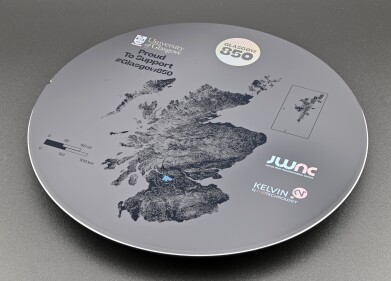
The University of Glasgow has established a cutting-edge magnetism laboratory designed to drive innovation in biomedical research and sensing technologies. The facility, featuring a state-of-the-art magnetically shielded room known as MuRoom, was officially unveiled on 24 February at the James Watt School of Engineering.
Developed with a £250,000 investment, the lab is specifically engineered to eliminate magnetic interference from external sources, including electronic devices and the Earth's natural magnetic field. This controlled environment allows researchers to develop highly sensitive devices capable of detecting the faint biomagnetic signals generated by human muscles (magnetomyography, MMG) and organs such as the heart (magnetocardiography, MCG) and brain (magnetoencephalography, MEG).
These magnetic-based technologies have the potential to revolutionise medical diagnostics and monitoring. Unlike traditional electrical methods, which require direct skin contact and are susceptible to interference, magnetic signals can be detected without direct contact, providing higher spatial resolution and enabling detailed 3D imaging of biological activity. This could lead to advancements in prosthetic limb control, wearable health monitoring devices, and human-computer interaction.
The lab is designed to foster collaboration between academia and industry, supporting research initiatives such as SUPREMISE, a project funded by the Engineering and Physical Sciences Research Council (EPSRC) that is exploring new applications of MMG. It will also serve as a development hub for Neuranics, a University of Glasgow and University of Edinburgh spinout focused on creating advanced spintronics-based sensor solutions for health, fitness, and extended reality (XR) applications.
Professor Muhammad Imran, Head of the James Watt School of Engineering, emphasised the lab’s importance: "This facility is a significant step forward for biomedical and sensing research in Scotland. By providing the highest level of magnetic shielding, we can explore new frontiers in medical technology and forge stronger partnerships between academia and industry."
Professor Hadi Heidari, the lab’s lead researcher and CTO of Neuranics, highlighted its transformative potential: "Three-dimensional measurements of magnetic signals could uncover medical conditions that traditional methods miss, such as ‘silent’ strokes. Our goal is to develop highly sensitive MMG sensors that could one day be integrated into everyday health monitoring devices, from credit card-sized heart monitors to wristbands controlling prosthetic limbs."
The launch event brought together key figures from the University of Glasgow, including Vice-Principal for Economic Development and Innovation, Uzma Khan, Vice-Principal for Research and Knowledge Exchange, Professor Chris Pearce, and Eric Yeatman, Head of the College of Science & Engineering.
More information online


Digital Edition
Lab Asia Dec 2025
December 2025
Chromatography Articles- Cutting-edge sample preparation tools help laboratories to stay ahead of the curveMass Spectrometry & Spectroscopy Articles- Unlocking the complexity of metabolomics: Pushi...
View all digital editions









Events
Jan 21 2026 Tokyo, Japan
Jan 28 2026 Tokyo, Japan
Jan 29 2026 New Delhi, India
Feb 07 2026 Boston, MA, USA
Asia Pharma Expo/Asia Lab Expo
Feb 12 2026 Dhaka, Bangladesh




