-
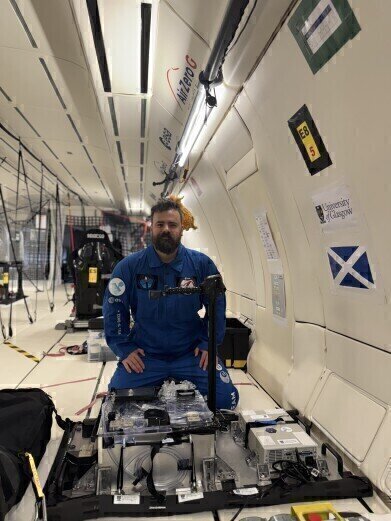 Dr Gilles Bailet.
Research news
Breakthrough advances space-based 3D printing
Jan 31 2025
Research breakthrough paves the way for future space-based 3D printing factories
Researchers at the University of Glasgow are one step closer to enabling 3D printing in space, bringing us closer to a future where orbital factories could manufacture components on demand. Dr Gilles Bailet, from the James Watt School of Engineering, has been awarded a patent for a system that solves the challenges of 3D printing in zero-gravity environments.
This groundbreaking technology has undergone extensive testing aboard the ‘vomit comet,’ a research aircraft that simulates microgravity during parabolic flights. Dr Bailet’s system uses a specialised granular material instead of traditional filaments, designed to work effectively in space's unique conditions. This innovation makes it possible to rapidly deliver material to the 3D printer’s nozzle, overcoming the limitations of conventional 3D printing methods.
Dr Bailet believes this advancement could lead to orbital factories capable of producing parts for new equipment in space. These parts could include solar reflectors for sustainable energy generation, advanced communication antennas, or even space-based drug production facilities capable of creating more effective pharmaceuticals.
"Our ability to 3D print in space could revolutionise manufacturing, freeing us from the constraints of rocket launches, which limit size and weight. We could create mission-specific structures in orbit, optimised for their tasks, while reducing resource consumption and waste," Dr Bailet explained.
The technology has been validated in a series of rigorous tests, including a recent demonstration in microgravity. During the flights, the team monitored the prototype’s performance in 90 brief periods of weightlessness, confirming that the system works as expected in space-like conditions.
The research also explores embedding electronics directly into printed materials, paving the way for the creation of functional components for use in space-based devices. This could make space manufacturing not only more efficient but also more versatile.
Looking ahead, Dr Bailet is focused on securing funding for the first in-space demonstration of his technology. Supported by the UK Space Agency and the University of Glasgow’s Knowledge Exchange Fund, the project aims to address the growing challenge of space debris while advancing in-space manufacturing technologies.
Dr Bailet’s work offers exciting possibilities, from the creation of solar power reflectors to advancements in drug development. As he concluded: “Space-based manufacturing has the potential to change how we think about technology production, with benefits that could extend far beyond space exploration itself.
More information online


Digital Edition
Lab Asia Dec 2025
December 2025
Chromatography Articles- Cutting-edge sample preparation tools help laboratories to stay ahead of the curveMass Spectrometry & Spectroscopy Articles- Unlocking the complexity of metabolomics: Pushi...
View all digital editions










Events
Jan 21 2026 Tokyo, Japan
Jan 28 2026 Tokyo, Japan
Jan 29 2026 New Delhi, India
Feb 07 2026 Boston, MA, USA
Asia Pharma Expo/Asia Lab Expo
Feb 12 2026 Dhaka, Bangladesh




