-
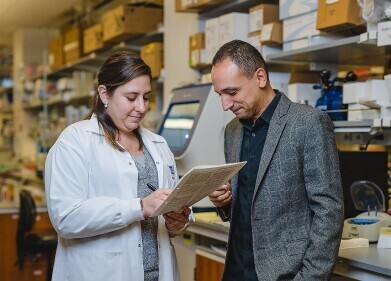 Professor Mohamed Abdel-Mohsen and colleague in lab (Credit: The Wistar Institute)
Research news
Pro-aging blood signature identified in people living with HIV
May 07 2024
Research led by the Wistar Institute’s professor Mohamed Abdel-Mohsen, PhD and other collaborators, have identified sugar abnormalities in the blood that may promote biological aging and inflammation in people living with HIV (PLWH).
Despite advances in HIV treatment, notably the success of antiretroviral therapy (ART) in suppressing the virus to undetectable levels, HIV remains incurable, with the virus persisting in a dormant state within the body. This chronic presence is linked to long-term health issues, including persistent inflammation and a higher prevalence of aging-related diseases such as cancer and neurocognitive disorders. These conditions tend to occur more frequently and at an earlier age in PLWH compared to the general population.
While many factors in the body can contribute to accelerated biological aging, researchers focused on a novel factor: abnormalities of the human glycome — the totality of the various sugar structures circulating throughout the body. Previous studies have established a connection between aging and shifts in the glycan composition of immunoglobulins (IgGs), which are critical for immune regulation. As people age, their IgGs lose anti-inflammatory properties and gain pro-inflammatory characteristics.
Abdel-Mohsen's research investigates whether living with a chronic viral infection, such as HIV infection, exacerbates these changes, leading to premature aging and related diseases.
By comparing glycan profiles in more than 1200 individuals, both with and without HIV, the team discovered that PLWH exhibit elevated levels of inflammatory and pro-aging IgG glycan signatures. In a remarkable step forward, the team developed a machine-learning model that uses these glycan signatures to estimate the biological age of PLWH and assess the rate of aging acceleration. This glycan signature also has the potential to predict the onset of comorbid conditions in PLWH, such as cancer, years in advance.
"Utilising glycan signatures to predict early onset of diseases in people living with HIV marks a pivotal shift towards proactive healthcare,” said Abdel-Mohsen. “This could significantly alter clinical outcomes, allowing for timely interventions and personalised treatment plans. The impact on treatment and management in the HIV community could be revolutionary. Beyond biomarkers, antibodies glycoengineered to mimic biologically younger glycans offer a new therapeutic avenue. This method could enhance immune responses, paving the way for innovative treatments.”
The findings, along with a full list of co-authors and support providers, are detailed in a new paper ‘Immunoglobulin G N-glycan Markers of Accelerated Biological Aging During Chronic HIV Infection, published in Nature Communications.
More information online




Digital Edition
Lab Asia Dec 2025
December 2025
Chromatography Articles- Cutting-edge sample preparation tools help laboratories to stay ahead of the curveMass Spectrometry & Spectroscopy Articles- Unlocking the complexity of metabolomics: Pushi...
View all digital editions









Events
Jan 21 2026 Tokyo, Japan
Jan 28 2026 Tokyo, Japan
Jan 29 2026 New Delhi, India
Feb 07 2026 Boston, MA, USA
Asia Pharma Expo/Asia Lab Expo
Feb 12 2026 Dhaka, Bangladesh




