-
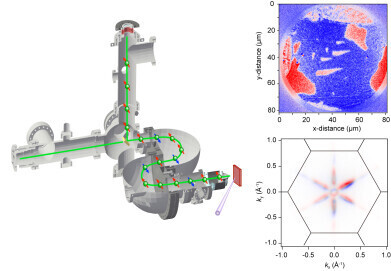 Schematic diagram of the iSPEM and the images it can obtain. Credit: Science and Technology of Advanced Materials: Methods (2024)
Research news
Innovating materials analysis with iSPEM
May 30 2024
Electron spin states can now be probed at higher resolutions and with greater efficiency, opening new opportunities in materials analysis and data processing technologies.
Researchers Koichiro Yaji and Shunsuke Tsuda at the National Institute for Materials Science in Japan have developed an advanced microscope that visualises key aspects of electron spin states. Electron spin, a quantum mechanical property related to an electron’s angular momentum, significantly impacts the electronic and magnetic behaviour of materials.
The new technology, called imaging-type spin-resolved photoemission microscopy (iSPEM), uses light interactions with electrons to detect their spin alignment. It specifically focuses on electron spin polarisation, which measures the collective alignment of electron spins in a specific direction.
The iSPEM system consists of three interconnected ultra-high vacuum chambers for sample preparation and analysis. Electrons emitted from the sample by absorbing light energy are accelerated through the apparatus and analysed using a spin filter crystal. The resulting images provide detailed information about the electron spin states.
“Compared to conventional machines, our iSPEM improves data acquisition efficiency by a factor of ten thousand, with over ten times better spatial resolution,” explained Yaji. “This breakthrough offers immense opportunities for characterising the electronic structure of microscopic materials and devices at sub-micrometre scales.”
This advancement is significant for the field of spintronics, where electron spin states are used to store and process information, supplementing traditional electric charge. Spintronics applications could lead to more energy-efficient and faster electronic devices, including quantum computers.
“This could lead to more energy-efficient and faster electronic devices, including quantum computers,” said Yaji. Harnessing quantum mechanical behaviours for computing is at the forefront of efforts to significantly boost computing power, transitioning from theoretical demonstrations to practical applications.
“We plan to use our machine to explore the development of a new generation of electron spin-based devices. It will allow us to investigate the properties of tiny and structurally complex samples that were previously hidden from view,” Yaji concluded.
The research was published in Science and Technology of Advanced Materials: Methods (STAM-M)
More information online




Digital Edition
Lab Asia Dec 2025
December 2025
Chromatography Articles- Cutting-edge sample preparation tools help laboratories to stay ahead of the curveMass Spectrometry & Spectroscopy Articles- Unlocking the complexity of metabolomics: Pushi...
View all digital editions










Events
Jan 21 2026 Tokyo, Japan
Jan 28 2026 Tokyo, Japan
Jan 29 2026 New Delhi, India
Feb 07 2026 Boston, MA, USA
Asia Pharma Expo/Asia Lab Expo
Feb 12 2026 Dhaka, Bangladesh




