-
-
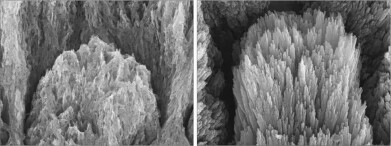 Electron microscopy images of a tooth with demineralised enamel showing eroded apatite crystals (left) and a similar demineralised tooth after a 2-week treatment showing epitaxially regenerated enamel crystals (right). Credit: University of Nottingham
Research news
Protein-based gel shows promise to repair tooth enamel and prevent decay
Nov 17 2025
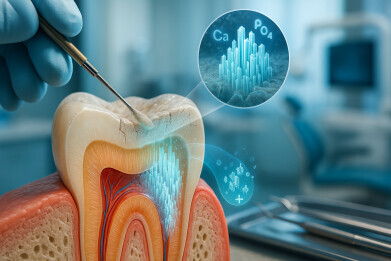
A fluoride-free, protein-based gel developed at the University of Nottingham, UK, has been shown to regenerate tooth enamel by guiding controlled mineral growth from saliva. The bioinspired material has the potential to repair erosion, strengthen vulnerable teeth, treat sensitivity and support longer-lasting restorations, with a first clinical product expected from start-up Mintech-Bio
A protein-based gel that imitates the way infant teeth develop their enamel has been used to regenerate damaged tooth surfaces, in work that could transform preventive and restorative dentistry. Researchers at the University of Nottingham’s School of Pharmacy and also its Department of Chemical and Environmental Engineering have developed a bioinspired material with the potential to restore demineralised or eroded enamel, strengthen healthy enamel and reduce the risk of future decay.
The gel can be applied rapidly to teeth in much the same way that dentists currently apply standard fluoride treatments. In contrast to these conventional approaches, the protein-based gel is fluoride free and imitates key features of the natural proteins that guide enamel growth in infancy. Once applied, the material forms a thin but robust layer that penetrates the tooth surface and fills microscopic holes and cracks.
It then acts as a scaffold that draws calcium and phosphate ions from saliva and promotes the controlled growth of replacement mineral through a process known as epitaxial mineralisation. In this way, the regenerated mineral can organise and integrate with the underlying tissue so that both the structure and functional properties of natural healthy enamel are restored.
The material can also coat exposed dentine and promote the formation of an enamel-like layer on top. This approach could help to treat hypersensitivity, where exposed dentine transmits pain in response to temperature or chemical stimuli and could improve the adhesion and longevity of dental restorations such as fillings or crowns.
Enamel degradation is a major driver of tooth decay and contributes to dental problems that affect almost 50% of the global population. These problems can lead to infection and tooth loss, and they can also be associated with systemic conditions such as diabetes and cardiovascular disease.
Enamel does not regenerate naturally; once you lose it, it is gone for ever. At present there is no clinically available solution that can regrow enamel in a controlled and durable way. Treatments such as fluoride varnishes and remineralisation solutions provide only partial relief by hardening tooth surfaces or slowing further damage rather than rebuilding lost tissue.
“Dental enamel has a unique structure which gives enamel its remarkable properties that protect our teeth throughout life against physical, chemical and thermal insults,” said Dr Abshar Hasan, a postdoctoral fellow and lead author of the study.
“When our material is applied to demineralised or eroded enamel, or exposed dentine, the material promotes the growth of crystals in an integrated and organised manner, recovering the architecture of our natural healthy enamel.
“We have tested the mechanical properties of these regenerated tissues under conditions simulating ‘real-life situations’ such as tooth brushing, chewing, and exposure to acidic foods, and found that the regenerated enamel behaves just like healthy enamel,” he added.
“We are very excited because the technology has been designed with the clinician and patient in mind,” said Professor Alvaro Mata, chair in biomedical engineering and biomaterials, who led the research.
“It is safe, can be easily and rapidly applied, and it is scalable. Also, the technology is versatile, which opens the opportunity to be translated into multiple types of products to help patients of all ages suffering from a variety of dental problems associated with loss of enamel and exposed dentine.
“We have started this process with our start-up company Mintech-Bio and hope to have a first product out by next year; this innovation could soon be helping patients worldwide,” he concluded.
For further reading please visit: 10.1038/s41467-025-64982-y



Digital Edition
Lab Asia Dec 2025
December 2025
Chromatography Articles- Cutting-edge sample preparation tools help laboratories to stay ahead of the curveMass Spectrometry & Spectroscopy Articles- Unlocking the complexity of metabolomics: Pushi...
View all digital editions










Events
Jan 21 2026 Tokyo, Japan
Jan 28 2026 Tokyo, Japan
Jan 29 2026 New Delhi, India
Feb 07 2026 Boston, MA, USA
Asia Pharma Expo/Asia Lab Expo
Feb 12 2026 Dhaka, Bangladesh




