Laboratory products
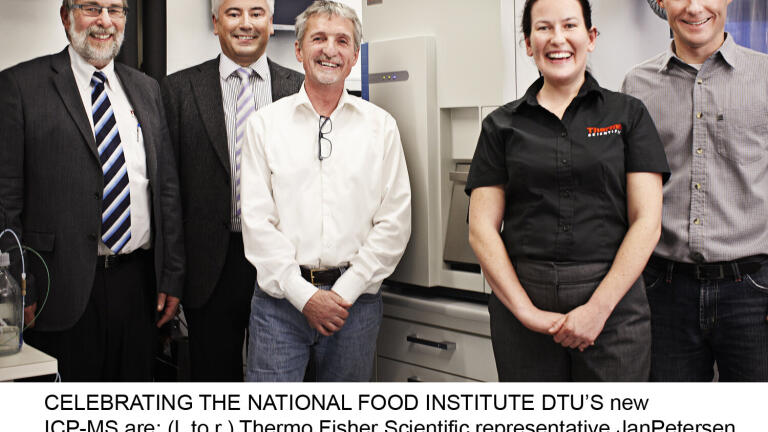
Thermo Fisher Scientific Inc has announced that The National Food Institute, Technical University of Denmark (DTU), has adopted a Thermo Scientific iCAP Q inductively-coupled plasma mass spectrometer (ICP-MS) for research supporting EU Commission development of standards for arsenic and nanomaterials in food.
Dr Erik Huusfeldt Larsen, Senior Researcher at The National Food Institute,(DTU) and his Metals, Minerals & Nano Group at DTU are using the iCAP Q ICP-MS system to determine the species of arsenic found in food samples. EU Commission researchers have found that it is no longer adequate to measure total arsenic in food because small amounts of inorganic arsenic can be associated with diseases such as cancers of the skin and bladder, while organic arsenic is much less toxic. Larsen notes that until recently, arsenic contamination was associated mainly with fish and other marine products; but in recent years, arsenic found in drinking water, rice and wheat have also attracted public attention.
This work supports the European Conffidence project, including inorganic arsenic. In this project, the iCAP Q instrument will be used for selective and sensitive detection of arsenic following solid phase extraction.
Dr Larsen’s group also collaborates on the EU-funded NanoLyse project for determination of nanoparticles including silver, silica and organic nanoparticles in the food matrix. The iCAP Q system will be used in ‘single particle’ ICP-MS mode for determination of metallic nanoparticles in food.
”This technology gives us the capability to detect and count individual nanoparticles in food, and this is very important,” said Dr Larsen. “We need to know more than just the size of the particles present, we must also be able to determine the number-based size distribution of particles in a sample. This matters because toxic effects are likely to be associated with the huge surface area of nanoparticles.”


.jpg)
-(2).jpg)