Laboratory products
NTNU NanoLab is a cross faculty, strategic initiative with the objective to coordinate and promote nanoscience and nanotechnology at NTNU. The laboratories are well-equipped with state of the art instrumentation designed to be used by as many researchers from as many disciplines as possible.
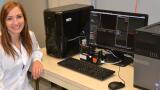
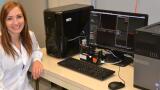
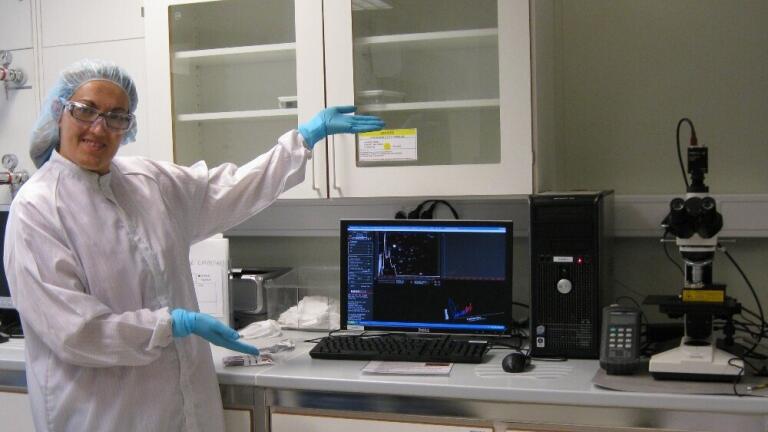
Katarzyna Psonka-Antonczyk is a post-doctoral fellow in the Biophysics and Medical Technology group within the Department of Physics. Her interests include the characterisation of nanovesicles (exosomes) with sizes ranging from 30 to a few hundred nanometers secreted by cancer cells to the extracellular matrix. Exosomes contain membrane proteins, cytosolic proteins and small RNAs (miRNA). These vesicles are transported by bodily fluids (blood) and can likely fuse back with plasma membranes, introducing new proteins and RNA in new cells distant from the cell of origin. She is applying single-molecule techniques like atomic force microscopy and total internal reflection fluorescence microscopy to visualise individual exosomes and to characterise their membrane repertoire.
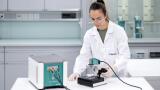
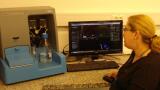
Knowing the concentration of secreted exosomes can facilitate estimation of the secretory abilities of cells and can help in further sample preparation. When coupled with fluorescent light, the NanoSight Nanoparticle Tracking Analysis system enables the analysis of exosome samples to provide information of various distinct subpopulations of vesicles by labelling with specific antibodies tagged with a fluorescent reporter.
Prior to using NanoSight, Dr Psonka-Antonczyk tried to employ dynamic light scattering but the results were rather irreproducible and not very reliable. In contrast, NanoSight exceeded her expectations. She said "NanoSight's system is simple and easy to operate in providing information on the exosomes concentration and size profile in a very short time. I can also use it as a test measurement providing the first glance on the exosomes before running more elaborate and time-consuming experiments."
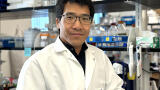
The range of applications for NTA at NanoLab is diverse. For example, metallic and magnetic nanoparticles used for biomedical applications including targeted drug delivery and MRI contrast enhancement are studied by Dr Gurvinder Singh. He likes the NTA approach because "it provides the determination of particle concentration, better resolution of particle size and size distribution with real time visualisation. This instrument is more impressive than DLS."
.jpg)
-(2).jpg)