Laboratory products
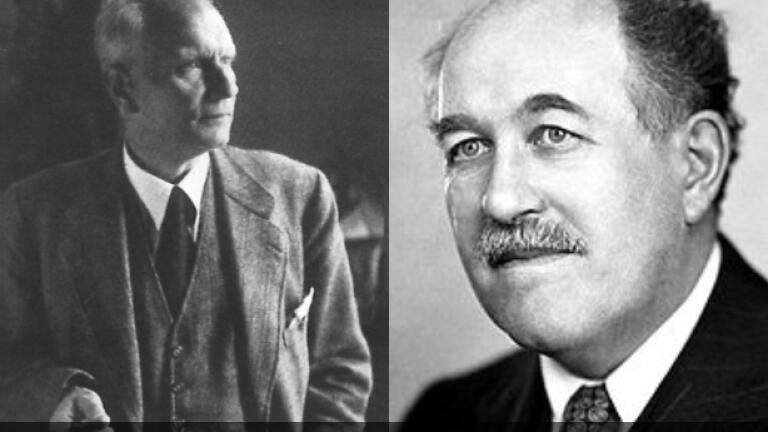
In 1922, Stern and Gerlach performed a simple experiment. Silver atoms were fired through a non-uniform magnetic field onto a screen. The impact of the silver atoms on the screen — in two distinct spots equidistant above and below the firing axis — cannot be explained by classical physics. The weird world of quantum mechanics is needed.
An atom’s magnetic properties are described by its magnetic dipole moment — and the dipole moment is proportional to the angular momentum of an atom. A magnetic dipole is simply an object that has magnetic properties, a small bar magnet or a loop of wire. A magnetic dipole moment is simply a way of characterizing the magnetic properties of the dipole, it is a vector quantity, and therefore has magnitude and direction.
The Stern-Gerlach experiment demonstrated that the magnetic dipole moment is quantized. If the dipole could take any value, a continuous band would be expected where the atoms hit the screen. In the case of the silver atoms used by Stern and Gerlach, only two values are allowed.
Furthermore, the results could not be explained by the orbital angular momentum. It had to be due to a different type of angular momentum.
Goudsmit and Uhlenbeck proposed the idea of spin in 1925, although it was Pauli (of exclusion principle fame) who coined the term spin. Goudsmit and Uhlenbeck suggested that there was a property of particles that behaved like angular momentum. This property has to be viewed as an intrinsic property like mass or charge; it cannot be separated from the particle.
So spin is a form of intrinsic angular momentum. Elementary particles such as electrons and protons have spin. Particles having a spin quantum number of s = ½ are known as spin-½ particles or fermions, and include electrons, protons and neutrons — the particles of interest in nuclear magnetic resonance (NMR).
When a spin-½ particle is in a magnetic field, the particle can either align with the field or align against the field. As the particles — in this case protons and neutrons — form nuclei, the nuclei have a net spin value. Sometimes the spin can cancel out as the numbers of protons and neutrons increase in a nucleus.
NMR can be used to observe nuclei having:
As these nuclei possess a net non-zero spin, and have a number of spin states determined by the nuclei’s spin quantum number.
For example, 1H has two spin states, which have different energies in a magnetic field due to the magnetic dipole moment either aligning with the field or opposite to the field. It is this property that allows 1H to be used in NMR. Nuclei having zero spin cannot be detected in NMR as they have no magnetic dipole moment.
To find out more about NMR have a look at: What is NMR?




.jpg)
-(2).jpg)