Laboratory products
LC-MS is a powerful analytical tool that combines two techniques and is used to determine the mass and structure of individual compounds found in a sample. The basic process is:
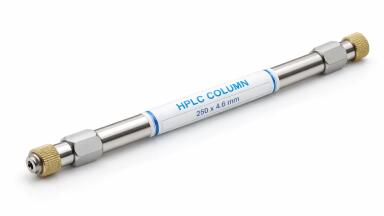
HPLC is a chromatographic technique used to separate a sample into its individual components. The basic principle is similar to that used in school chemistry labs to separate ink spots. Filter paper and water is used to reveal the individual pigments that make up each ink colour. The pigments separate out as the water flows through the filter paper because the pigments dissolve at different rates. The relative attraction of the pigments to the water and paper produces the separation. A similar process happens in a HPLC column, only this time it is the relative affinity of the components in the sample for the stationary (solid) phase and mobile (liquid) phase. The solid phase is the packing in the column, the mobile phase the liquid flowing through it.
Various factors affect the separation. To allow complete separation these variables are optimized. These variables include:
HPLC uses several different detectors to detect the separated compounds as they leave the column. The use of mass spectroscopy as the detector offers a high resolution and sensitivity.
Mass spectroscopy is a technique used to measure the number of particles as a function of their mass/charge ratio (m/e). There are three main steps in measuring the mass spectrum of a compound:
The output from an MS is a graph of the relative abundance of ions at a given m/e ratio. From this spectrum, an analysis can yield information on the structure of the compound.
The first attempt to use mass spectroscopy and HPLC came in the late 1960’s. LC-MS systems became commercially available in the 1980s due to advances in instrument techniques. As techniques advanced further, LC-MS instruments became easier to use. This allowed a wider community of scientists to use them. Due to the sensitivity of the detector, LC-MS became widely used in the drug discovery industry, particularly in detecting drug metabolites.
Nowadays, the technique is not just confined to drug development. LC-MS played an important role in the detection of adulterated meat in the recent horsemeat food scandal.


.jpg)
-(2).jpg)