Chromatography
Fully Automated Iodine Adsorption Number for the Determination of Surface Area.
Oct 30 2007
Carbon blacks are powdered forms of highly dispersed elemental carbon manufactured by controlled vapour-phase pyrolysis of hydrocarbons. There are a number of different types of carbon black, produced by different industrial processes, including acetylene black, channel black, furnace black, lamp black and thermal black. Average particle diameters in several commercially produced carbon blacks range from 0.01 to 0.4 micrometres (µm), while average aggregate diameters range from 0.1 to 0.8µm. Most types of carbon black contain over 97 to 99% elemental carbon. Carbon blacks may also contain chemically bound hydrogen, oxygen, nitrogen and sulfur. The oxygen content is of greatest importance for their application. Oxygen is bound to the surface in the form of mainly acidic or basic functional groups. Because of their source materials, the methods of their production and their large surface areas and surface characteristics, commercial carbon blacks typically contain varying quantities of adsorbed by-products from the production processes, particularly aromatic compounds. Typical classes of chemicals adsorbed onto the carbon black surface are carcinogenic polycyclic aromatic hydrocarbons (PAHs), nitro derivatives of PAHs and sulphur-containing PAHs.
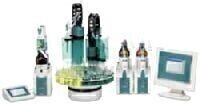
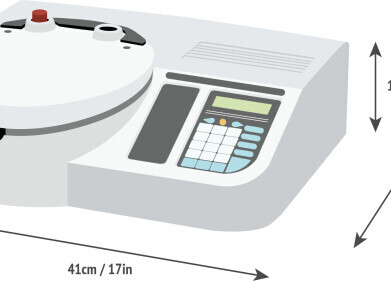
Analysts see the endpoints at different points because the method is so subjective. Metrohm have developed a method to completely automate this difficult procedure. The fully automated system consists of a 2 Tower Version 778 Robotic Sample Processor in combination with a 794 Basic Titrino. A combined Pt ring Metrosensor is used as the indicator electrode.
The sample rack accommodates 24 x 75 ml beakers. Sample preparation and reaction takes place on tower 1. 50 ml of iodine is added directly to 1 g of carbon black via a 800 Dosino, and is agitated and then allowed to settle. Pipetting and filter rinsing takes place on tower 2. 10 ml of the reacted iodine/carbon black sample is pipetted via another 800 Dosino through a special filter apparatus, and into the external titrating vessel, where the redox titration with sodium thiosulphate takes place. The filter apparatus is then back flushed with more iodine again using the 800 Dosino. The internal membrane pump adds diluent water prior to the titration. The same pump rinses the external titration vessel and the electrodes with a sophisticated spin rinse spray nozzle. The use of a 772 pump unit, attached directly to the 778 Robotic Sample Processor, guarantees an effective aspiration of the sample after titration. The whole system is controlled by Tiamo Titration software.
Analysts see the endpoints at different points because the method is so subjective. Metrohm have developed a method to completely automate this difficult procedure. The fully automated system consists of a 2 Tower Version 778 Robotic Sample Processor in combination with a 794 Basic Titrino. A combined Pt ring Metrosensor is used as the indicator electrode.
The sample rack accommodates 24 x 75 ml beakers. Sample preparation and reaction takes place on tower 1. 50 ml of iodine is added directly to 1 g of carbon black via a 800 Dosino, and is agitated and then allowed to settle. Pipetting and filter rinsing takes place on tower 2. 10 ml of the reacted iodine/carbon black sample is pipetted via another 800 Dosino through a special filter apparatus, and into the external titrating vessel, where the redox titration with sodium thiosulphate takes place. The filter apparatus is then back flushed with more iodine again using the 800 Dosino. The internal membrane pump adds diluent water prior to the titration. The same pump rinses the external titration vessel and the electrodes with a sophisticated spin rinse spray nozzle. The use of a 772 pump unit, attached directly to the 778 Robotic Sample Processor, guarantees an effective aspiration of the sample after titration. The whole system is controlled by Tiamo Titration software.
Digital Edition
Lab Asia Dec 2025
December 2025
Chromatography Articles- Cutting-edge sample preparation tools help laboratories to stay ahead of the curveMass Spectrometry & Spectroscopy Articles- Unlocking the complexity of metabolomics: Pushi...
View all digital editions









Events
Jan 21 2026 Tokyo, Japan
Jan 28 2026 Tokyo, Japan
Jan 29 2026 New Delhi, India
Feb 07 2026 Boston, MA, USA
Asia Pharma Expo/Asia Lab Expo
Feb 12 2026 Dhaka, Bangladesh




