Labmate Awards for Excellence 2025
HEL Group – Thermal Safety Unit
May 12 2025
Best lab safety
product or solution
Thermal Hazards in Process Scale-Up. Scaling up benchtop chemical reactions to production volumes is crucial in industry- from pharmaceuticals through to fine chemicals – but it does carry a huge number of risks and challenges. Central to these risks are the changes in heat loss behavior that are seen when increasing the scale of a reaction.
Many reactions are exothermic, and therefore require cooling to ensure safe operation. Added to which, components in the reaction may also become unstable under certain operating conditions, leading to additional thermal hazards. Uncontrolled reactions can lead to rapid temperature and pressure spikes, causing thermal runaways, explosions, compounded by toxic releases.
At the same time, incidents caused by process failures can lead to production stops, regulatory fines, and reputational damage, negatively impacting both short- and long-term business success. It is therefore critical that thermal and pressure hazards are identified and quantified early and on a benchtop scale, in order to facilitate safe process scale up and maximize operational efficiency.
The first stage in the process safety workflow is discovery, which maps the safest and most efficient route for synthesizing a target molecule and includes chemical reaction route selection and thermal screening;. By evaluating safety, complexity, and cost, researchers can ensure that decisions made early in the process minimize risk.
Characterizing Thermal Behavior in Lab-Scale Reaction Mixes
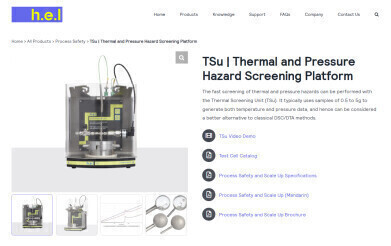
In order to facilitate the rapid screening of thermal and pressure hazards, H.E.L Group developed the Thermal Screening Unit (TSu), which is capable of characterizing sample pressure changes as well as thermal behaviour, as part of process scaleup. This enables representative samples of a reaction mix to be screened, providing reliable data on reactants, intermediates, and products.
The user-friendly and compact design is easy to operate, with a small footprint, and quick set-up times, making the TSu suitable for all types of labs. The accompanying software is simple and powerful, with a customizable interface and real-time sensor readings. This automation software is also common across H.E.L Group’s full product portfolio, allowing easy integration into workflows.
The TSu also contains built-in safety features, with automatic, user-configurable hazard detection and shutdown systems to ensure user safety, as well as automatic hardware and software fail-safes.
Thermal Screening in the Manufacture of Rocket Fuel
In 2024, researchers from the Institute of Industrial Organic Chemistry in Poland used the TSu to conduct thermal hazard studies on the azidation process in the preparation of tetra functional glycidylazide polymer (t-GAP), a synthetic potential energetic binding polymer used in propellants and explosives to improve cohesion and ensure steady combustion of fuel in rockets, missiles, and space vehicles.
The azidation reaction uses a metal azide, which is known to be highly sensitive to temperature, and therefore must be conducted under strictly controlled conditions. They are generally exothermic, meaning the total heat output becomes a major concern during process scale up. Additionally, large volumes of sodium azide remains suspended in the reaction mixture, which creates an explosion hazard and causes catastrophic effects if exposed to increased temperature for a prolonged period of time. This combination of safety hazards led researchers to carrying out a systematic study to identify reaction hazards ahead of process optimization and scale up.
In this study, the TSu was deployed to determine the temperature sensitivity of the azidation reaction, with the reaction pressure and temperature measured as a function of time. The reaction was found to be stable up to 110 °C without any thermal runaway conditions. Data generated was used to optimize reaction parameters, reducing reaction time and eliminating explosion and fire hazards. Results of the study have led to the development of a rapid, safe, cost-effective scaled-up process for the production of t-GAP, facilitating the manufacture of more efficient rocket fuels.
Process Safety: Fundamental in all Laboratories
The TSu also supports the development of accurate process safety data sheets (PSDS), a critical part of any laboratory-based research or manufacturing. By evaluating the thermal and pressure changes in small sample volumes, thermal screening provides onset temperatures, thermal rise rates, and safe temperature thresholds, enabling safe material storage and process scale-up. These results form the foundation of PSDS, guiding safe production practices and ensuring regulatory compliance.
At its core, the TSu, and process safety in general, is more than just a regulatory requirement – it safeguards people, facilities, products, and reputation, preventing thermal runaways, fires, and subsequent explosions. Ongoing safety testing and optimizing of reaction conditions will remain pivotal in advancing and scaling up chemical synthesis and manufacturing processes.


Digital Edition
Lab Asia Dec 2025
December 2025
Chromatography Articles- Cutting-edge sample preparation tools help laboratories to stay ahead of the curveMass Spectrometry & Spectroscopy Articles- Unlocking the complexity of metabolomics: Pushi...
View all digital editions










Events
Jan 21 2026 Tokyo, Japan
Jan 28 2026 Tokyo, Japan
Jan 29 2026 New Delhi, India
Feb 07 2026 Boston, MA, USA
Asia Pharma Expo/Asia Lab Expo
Feb 12 2026 Dhaka, Bangladesh




