Microscopy & microtechniques
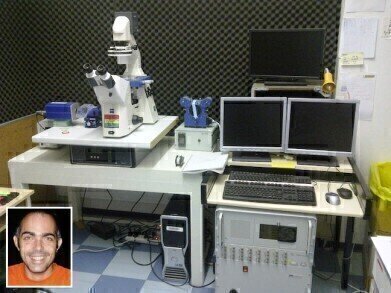
AFM System used for Cell Study Research in the Marseille INSERM/CNRS Laboratories
Aug 17 2012
Dr Pierre-Henri Puech is an INSERM staff scientist in the group of Pierre Bongrand working on forces at the molecular and cellular level to determine what are the physical cues that cells integrate in feeling and understanding their environment. He works on describing, among other topics, what are the physical parameters that a T cell measures when scanning an antigen presenting cell (APC). This is to determine whether the cell or the organism is facing an external perturbation such as a virus invasion or modification due to deterioration of cells, such as via cancerous transformation. Since this recognition goes through the interaction between the T cell receptor (TCR) and a peptide presenting protein (pMHC) at the surface of the APC, is it the duration of the bond between the pMHC and TCR (or off rate), its strength, its on-rate or the interaction with the cytoskeleton that is the determining mechanisms of the read-out. Using fluorescence microscopy coupled to AFM, the question ‘how does this signal, mechanical or adhesive / recognition get integrated by the cell in order to understand and take a decision to change its function (for example either becoming activated or not)’ can be addressed using phosphorylation or calcium reporting dyes. Such approaches are extended to cell cancer studies and to parasite / host interactions.
Before adding AFM to his techniques, Dr Puech used various micropipette-based techniques such as Biomembrane Force Probe, fluorescence microscopy, interference microscopy and simple microfluidic devices. In talking about working with JPK and their NanoWizard AFM system, Dr Puech said: "It is simple and robust to use. It is designed for biological applications. It is particularly user friendly so that a biology student with no knowledge in instrumentation can learn it in less than a month. The AFM can be easily coupled to other techniques such as optics. I like the software because of it being Linux-based with open access. It comes with user-friendly force curve and image processing software, and also you can program the system using an easy to learn language (Jython) to follow non-standard procedures. Lastly, I think that JPK's technical support staff is very competent. I like their nice, efficient and rapid approach to helping me and my users."
.jpg)
-(2).jpg)
Digital Edition
Lab Asia Dec 2025
December 2025
Chromatography Articles- Cutting-edge sample preparation tools help laboratories to stay ahead of the curveMass Spectrometry & Spectroscopy Articles- Unlocking the complexity of metabolomics: Pushi...
View all digital editions








Events
Jan 21 2026 Tokyo, Japan
Jan 28 2026 Tokyo, Japan
Jan 29 2026 New Delhi, India
Feb 07 2026 Boston, MA, USA
Asia Pharma Expo/Asia Lab Expo
Feb 12 2026 Dhaka, Bangladesh




