Mass spectrometry & spectroscopy
Report on the use of Benchtop NMR system at the Rochester Institute of Technology
Apr 03 2014
Dr Joseph Hornak is Professor of Chemistry and Imaging Science at the Rochester Institute of Technology, RIT, where he teaches courses in magnetic resonance imaging, nuclear magnetic resonance spectroscopy, analytical chemistry, and physical chemistry. He is also Director of the Magnetic Resonance Laboratory, MRL, a research and development laboratory on the RIT campus. Dr Hornak is author of more than 170 published and conference papers on magnetic resonance related topics.
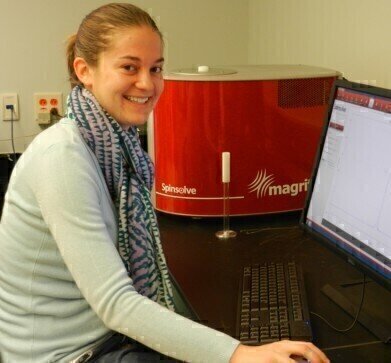
MRL is a research and development laboratory devoted to solving real world problems using magnetic resonance. Currently the lab is working on a phantom for fMRI, developing applications for low frequency electron paramagnetic resonance, and measuring relaxivities of some targeted MRI contrast agents. Dr Hornak's student, Amy Becker, a 2nd year Imaging Science student at RIT, is working on the analysis end of the project involving the contrast agents. The project is a collaboration with a research group headed by Dr Hans Schmitthenner which is synthesising some unique, targeted MRI contrast agents. Amy's project is to measure the NMR relaxivity of the agents. As with all contrast agents, you want to know the relaxivity at the field strength they will be used. Most clinical MRI systems in the world operate at a field strength of between ~0.75 and 3.0 Tesla. MRL chose the Magritek Spinsolve system because it operates at ~1 Tesla and is therefore a perfect instrument for getting these values at the low end of this range.
Speaking of the selection of the Magritek system, Dr Hornak said "We chose the Spinsolve NMR for use in an Instrumental Analysis laboratory with 90 students. In addition to NMR, students get exposure to UV-Vis, fluorescence, AA, and IR spectroscopies. We wanted an NMR with a low operating cost which could be sited in the lab, and leave the students with a positive NMR experience. Just like with the Terranova from Magritek, the Spinsolve scores high points for ease of use, both in collecting and processing the data. Shimming is easy and does not need to be performed on each sample. The resolution is sufficient for students to easily analyse 1- and 2-D H spectra of small molecules. It can be used to measure spin-lattice and spin-spin relaxation times at 40 MHz that we cannot take with other instruments."
Digital Edition
Lab Asia Dec 2025
December 2025
Chromatography Articles- Cutting-edge sample preparation tools help laboratories to stay ahead of the curveMass Spectrometry & Spectroscopy Articles- Unlocking the complexity of metabolomics: Pushi...
View all digital editions



Events
Jan 21 2026 Tokyo, Japan
Jan 28 2026 Tokyo, Japan
Jan 29 2026 New Delhi, India
Feb 07 2026 Boston, MA, USA
Asia Pharma Expo/Asia Lab Expo
Feb 12 2026 Dhaka, Bangladesh