Laboratory products
Real-time Imaging of Pharmaceutical Tablet Dissolution
Jun 15 2009
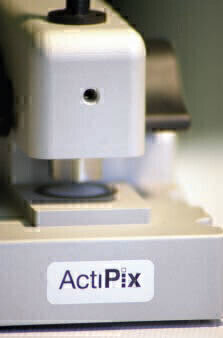
Using the new ActiPix Dissolution Imager from Paraytec, formulation scientists are able ‘to see’ in real-time what is happening at a tablet surface during the process of dissolution. Launched at Pittcon the new product offers pharmaceutical companies a powerful tool that can reduce the time it takes a drug to come to market, thereby offering significant potential gains in earnings.
The development of most modern drug therapies requires advanced drug formulations. It is important therefore to understand the mechanism of drug release behaviour, as this regulates the performance of many solid pharmaceutical dosage formulations. To date only high cost, complex to use techniques such as Terahertz Spectroscopic Imaging and Magnetic Resonance Imaging (MRI) have been able to solicit the data to enable formulation scientists to understand complex pharmaceutical drug release processes.
The ActiPix Dissolution Imager overcomes these limitations and provides for the first time a truly affordable dissolution imaging capability for scientists that does not require expert operation.
Using a specially designed tablet holder - controlled release pharmaceuticals can be studied using Paraytec’s multi-award winning ActiPix D-100 UV area imager. The holder is placed inside the ActiPix D-100, which enables real time recording and review of data. When liquid flows over the surface of the formulation, release of the active ingredient can be quantitatively monitored directly at the tablet surface.
The ActiPix D100 is the world’s first quantitative UV area imaging system. The miniature detector contains a high resolution 1280x1024 Active Pixel sensor. Compact in design, the ActiPix D100 consists of a control box connected via a fibre optic cable and communications cable to a remote sensor head. The sensor head holds easily exchangeable, application-specific cartridges. The cartridges are used in conjunction with powerful software, enabling the end-user to easily switch between applications. The detector can be used as a ‘plug and play’ accessory linked in-line to single or multiple peripheral devices, such as syringe pumps, existing CE or nanoLC instrumentation. These can be further coupled to other devices such as mass spectrometers giving a greater depth of information. Detection is performed at a selected wavelength by means of interchangeable filters. The detector wavelength range is 190 to 1100 nm.

Digital Edition
Lab Asia Dec 2025
December 2025
Chromatography Articles- Cutting-edge sample preparation tools help laboratories to stay ahead of the curveMass Spectrometry & Spectroscopy Articles- Unlocking the complexity of metabolomics: Pushi...
View all digital editions










Events
Jan 21 2026 Tokyo, Japan
Jan 28 2026 Tokyo, Japan
Jan 29 2026 New Delhi, India
Feb 07 2026 Boston, MA, USA
Asia Pharma Expo/Asia Lab Expo
Feb 12 2026 Dhaka, Bangladesh




