Laboratory products
Studying the Size of Nanogels used in Developing Drug Delivery Vehicles
Mar 29 2010
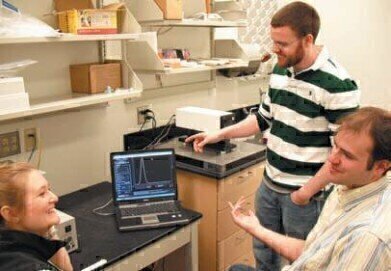
The School of Chemistry & Biochemistry at Georgia Institute of Technology has chosen the NanoSight LM-20 system to help in the characterisation of dimensional changes of nanogels used in the development of drug
delivery vehicles for macromolecular therapeutics.
The GIT research group of Professor Andrew Lyon works on the development and implementation of new, environmentally responsive (or ‘smart’) materials for photonic materials, bioanalysis, and biomimetics.
The approach the group is taking is to design hydrogel nanoparticles that undergo large changes in their chemical, mechanical, optical, or electrical makeup in response to a chemical stimulus, biomolecular interaction, or
electromagnetic field; such materials can be viewed as amplifiers or sensitisers of the environmental event. As a result of their environmental sensitivity, nanogels have potential in a number of applications.
Principal user is PhD candidate, Michael Smith. He has been very impressed with the instrument. “The NanoSight has been an enabling tool for us in the characterisation of dilute nanogel samples, where DLS fails to produce reliable correlation data. For instance, in our recent investigations of degradable nanogels, we used the NanoSight for sizing and number density estimation throughout the erosion reaction. In these studies, sample concentrations were typically very low at later stages of the degradation reaction (due to particle loss). Similarly, the NanoSight is effective at measuring the fractionated samples from Asymmetrical flow field-flow fractionation (where samples are greatly diluted following separation).”
Smith continued: “The LM-20 has also been used to characteris e a variety of other particle types in the group in conjunction with other light scattering and microscopy methods, to provide topological information for various nanoparticles.” NanoSight’s approach, known as Nanoparticle Tracking Analysis (NTA), has been shown to be ideally suited to both research and process control use. The system is an extremely powerful nanoscale research and development tool for looking a broad range of particle types and concentrations.


Digital Edition
Lab Asia Dec 2025
December 2025
Chromatography Articles- Cutting-edge sample preparation tools help laboratories to stay ahead of the curveMass Spectrometry & Spectroscopy Articles- Unlocking the complexity of metabolomics: Pushi...
View all digital editions









Events
Jan 21 2026 Tokyo, Japan
Jan 28 2026 Tokyo, Japan
Jan 29 2026 New Delhi, India
Feb 07 2026 Boston, MA, USA
Asia Pharma Expo/Asia Lab Expo
Feb 12 2026 Dhaka, Bangladesh




