Laboratory products
Nanoparticle Characterisation System Aids Water Desalination and Reuse Research Programmes
Jan 20 2011
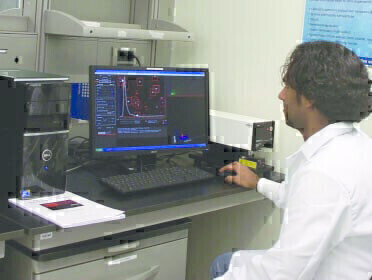
Installation and training of a NanoSight LM20 nanoparticle characterisation system has been completed at the prestigious King Abdullah University of Science and Technology, Saudi Arabia.
The Water Desalination & Reuse Research Centre is part of King Abdullah University for Science & Technology, located at Thuwal beside Jeddah city in the Kingdom of Saudi Arabia. The mission for the Centre is to contribute research and development toward the integrated and sustainable exploitation of impaired-quality drinking water sources with a minimisation of energy use, chemical use, waste residuals, and environmental impact and carbon footprint. Nanoparticle size and count is vital to these research activities and the Division has selected the NanoSight LM20 employing nanoparticle tracking analysis, NTA, to aid their research.
The Laboratory Manager is Dr Faisal Wali. He described what is important for the research activity: “Our problem is colloidal fouling. This is because it causes interruption in the membrane processes. Researchers are looking for different possibilities to avoid particle contamination prior to their direct interaction with membranes. To get around this challenge, the correct and accurate detection of the nanoparticles in different kinds of water is required.”
He continued: “The Centre seeks to study the treated sea water after using different types of membranes. The data collected using the NanoSight LM20
will provide a guide to understand on how membranes affect the removal of nanoparticles and get more information on what is in our sea water.”
“As well as using NanoSight’s LM20 system, the Centre is using a variety of other established particle characterisation techniques such as Dynamic Light Scattering (DLS) and NIBS (non-invasive back scatter) technology. However, each has deficiencies in terms of parameters such as sample preparation and speed of use. NanoSight has the unique advantage of providing particle sizing and counting in real time, recorded in a video file, which may be used for further calculations.
Because we are able to visualise the sample, we have more confidence in our results. Individual particle tracking enables a much better peak resolution than DLS so making it better suited to the study of well-treated water. It gives an approximate particle concentration while letting us see bacterial contamination easily as ‘swimming’ particles.”
Digital Edition
Lab Asia Dec 2025
December 2025
Chromatography Articles- Cutting-edge sample preparation tools help laboratories to stay ahead of the curveMass Spectrometry & Spectroscopy Articles- Unlocking the complexity of metabolomics: Pushi...
View all digital editions









Events
Jan 21 2026 Tokyo, Japan
Jan 28 2026 Tokyo, Japan
Jan 29 2026 New Delhi, India
Feb 07 2026 Boston, MA, USA
Asia Pharma Expo/Asia Lab Expo
Feb 12 2026 Dhaka, Bangladesh




