Laboratory products
Production of Mixtures on a Laboratory Scale
Oct 11 2011
Mixed were solid with solid substances, solid with liquid substances and liquids with solids. As solid phases mostly fine powders are used, which during the mixing process should not be further reduced. The liquid phases include
mercury to saline solutions up to resins.
Probably one of the most difficult tasks was the fine distribution of pure liquid mercury in a mixture of fine solid metal powders. Already during the manual mixing with a spatula, with careless work methods without a problem up to 3mm large amalgam grains were produced. The solution was added to the mortar mill PULVERISETTE 2, with an agate grinding set and special adjustments for the minimising of the application of energy found.
From the area of mixtures liquid – solid is the production of filled pastes to be mentioned. Especially challenging here is to add as much as possible solids in the high viscosity organic phase.
An additional example for this is, when one has to add to organic binder (for example synthetic resin or varnish or in the
simplest case oil) fine metallic, ceramic or inorganic powders. High viscosity pastes evolve which can be compared which shoe polish in a tube. Experts often talk about filled composite materials. Often the increase of the degree of the solid content is the goal of all activities.
In this concrete case, was a metallic powder to be added to a synthetic resin of high viscosity. Chosen was the Fritsch
mortar mill PULVERISETTE 2, equipped with a grinding set of hardened steel. With processing times of up to 30 minutes, the successive addition of the powder and supported by the slight warming from the applied comminution energy, up to 80% of the mass percentage of the solid was homogenously mixed in. From the areas of mixtures solid – liquid the contamination of ceramic powders with very little amounts of solved in liquid substances are to be mentioned. For the test the mortar mill PULVERISETTE 2 with an agate grinding set was chosen.
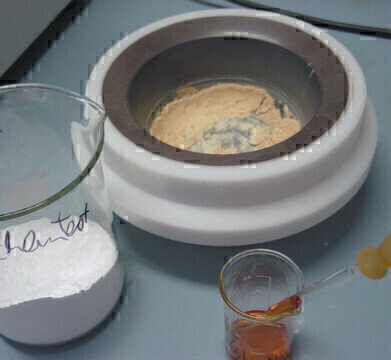
The iron nitrate solution was used as the model-solution coloured and therefore the homogeneity of the mixture was very easily visually evaluated. While the mill was grinding, approximately 1ml liquid in 50g powder were instilled. Afterwards it was further homogenised. After 5 minutes a visual consistent system was created.
Digital Edition
Lab Asia Dec 2025
December 2025
Chromatography Articles- Cutting-edge sample preparation tools help laboratories to stay ahead of the curveMass Spectrometry & Spectroscopy Articles- Unlocking the complexity of metabolomics: Pushi...
View all digital editions










Events
Jan 21 2026 Tokyo, Japan
Jan 28 2026 Tokyo, Japan
Jan 29 2026 New Delhi, India
Feb 07 2026 Boston, MA, USA
Asia Pharma Expo/Asia Lab Expo
Feb 12 2026 Dhaka, Bangladesh




