Laboratory products
Parallel Reactor Improves Development of Novel Hydrogenation Catalysts
Jun 08 2020
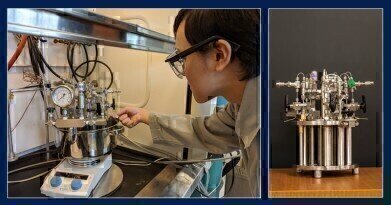
The Chianese Organometallic Chemistry group at Colgate University are using a custom designed Multicell Parallel High-Pressure Reactor from Asynt to conduct reproducible hydrogenation experiments in parallel, to rapidly determine the kinetic properties of their novel catalysts.
The research activities of the Chianese group focuses on the development of new transition metal complexes for catalysing the hydrogenation of polar compounds. To accelerate this process the group wanted a high-pressure reactor capable of conducting many hydrogenation reactions at once, with rigorous control of the initial concentrations and reaction temperature. They also needed the ability to take and analyse reaction aliquots over the time course of the reaction, which could then be used to for kinetic profiling.
Associate Professor Anthony Chianese, head of the group, commented: “By working with the technical team at Asynt we were able to specify a custom version of their Multicell parallel high-pressure reactor that exactly fitted our needs. Before we had the Multicell we were running several test tube reactions within a single batch reactor, meaning that we could only conduct analysis at the end and would often experience contamination between samples. The Multicell now allows us to run many reactions in parallel with no detectable crossover between the headspace of different cells. Importantly, because we can now analyse aliquots while the reactions are running, it is possible to rapidly determine reaction rates for any given catalytic hydrogenation. Often our organometallic catalysts are highly air sensitive, so it is great to be able to assemble our Multicell reactor inside a glovebox then bring it out to run the reactions. We also really like the fact that the whole unit is user-serviceable with all of the parts, aside from the cells themselves, easily replaceable if there is an issue.”
When asked if he would recommend the system to other researchers, Professor Chianese responded: “Yes. I think most researchers only analyse hydrogenation reactions at the endpoint because they don’t have a way to take aliquots. With the Asynt Multicell you can study hydrogenation reactions much more quickly, efficiently and in more detail than was previously possible.”
The Multicell high pressure reactor is designed for undertaking experiments including carbonylation, hydrogenation, catalysis and supercritical fluid reactions, as well as air sensitive material studies. Used in conjunction with a hotplate stirrer the standard 316 stainless steel Multicell reactor offers users the ability to undertake 10 x 30 mL reactions in parallel at pressures of up to 50 bar and temperatures up to 200°C. To increase the versatility of this high-performance system, Asynt can work with the end user on specific customisation to enhance the capabilities of the Multicell towards certain applications. Options include the ability to make additions/take samples under pressure, increased operating conditions up to 350°C and 200 bar, a 4-position system offering reaction volumes of up to 150 mL, sub-ambient reactor cooling, and the ability to have different temperatures and pressures in each reactor cell.


Digital Edition
Lab Asia Dec 2025
December 2025
Chromatography Articles- Cutting-edge sample preparation tools help laboratories to stay ahead of the curveMass Spectrometry & Spectroscopy Articles- Unlocking the complexity of metabolomics: Pushi...
View all digital editions









Events
Jan 21 2026 Tokyo, Japan
Jan 28 2026 Tokyo, Japan
Jan 29 2026 New Delhi, India
Feb 07 2026 Boston, MA, USA
Asia Pharma Expo/Asia Lab Expo
Feb 12 2026 Dhaka, Bangladesh




