Chromatography
Raman Spectroscopy New Wonder Material
Oct 10 2011
The Nobel Prize in Physics 2010 was awarded to Professors Andrew Geim and Konstantin Novoselov for their isolation and characterisation of the novel advanced material graphene. First report in Science in 2004, graphene consists of a single-atom-thick sheet of carbon atoms arrayed in a honeycomb pattern.
It is the thinnest, yet strongest, material known, being both brittle and ductile simultaneously. Thus, it exhibits excellent transport properties which make it a promising material for future nanoelectronic devices, namely for high-electronmobility transistors (HEMT).
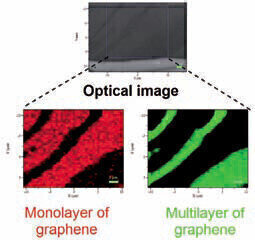
Due to its scale and optical properties, graphene is hardly visible on most substrates. However, distinguishing the number of graphene layers as well as quantifying the impact of disorder on its properties is critical for the study of graphene-based devices.
Raman micro spectroscopy has proven to be very sensitive for determining both of these properties. Indeed, with its high structural selectivity, combined with both spectral and spatial resolution, this technique can detect edges or defects at the micron scale. The strong Raman efficiency of the graphene enables to cover large surfaces in record time and thus localise mono-, bi- or multi-layers very rapidly. The non-destructive nature of this technique is also a considerable advantage to protect the quality characteristics of this wonder material.
Digital Edition
Lab Asia Dec 2025
December 2025
Chromatography Articles- Cutting-edge sample preparation tools help laboratories to stay ahead of the curveMass Spectrometry & Spectroscopy Articles- Unlocking the complexity of metabolomics: Pushi...
View all digital editions








Events
Jan 21 2026 Tokyo, Japan
Jan 28 2026 Tokyo, Japan
Jan 29 2026 New Delhi, India
Feb 07 2026 Boston, MA, USA
Asia Pharma Expo/Asia Lab Expo
Feb 12 2026 Dhaka, Bangladesh




