Mills and grinders
Use of Laboratory Mills in WEEE and RoHS Tests
Mar 19 2007
The directives 2003/108/EC (WEEE) and 2002/95/EC (RoHS) of the European Union have opened up new applications for Fritsch GmbH laboratory mills. These directives regulate the collection of electronic components by the manufacturer and limit the use of problematic substances such as chromium or mercury in the manufacture of electrical and electronic products. Compliance with these directives must be verified through appropriate analysis, meaning that laboratories performing such tests require suitable mills for sample preparation.
The circuit boards which need to be ground are comprised of a mixture of substances. Metals, ceramic components and various plastics: these will all be found in the samples. In order to achieve a fineness appropriate for analysis (
One decisive advantage of the pulverisette 19 in comparison with the competition is the very simple and fast cleaning of the mill, which allows a high sample throughput.
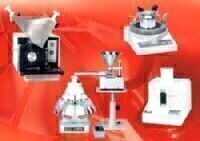
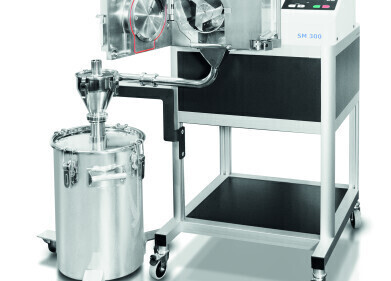
As only a relatively small amount of material is required for the analysis but which must be representative we comminute significantly more than the few grams of sample needed using the universal cutting mill pulverisette 19 and divide this with the Fritsch rotary cone sample divider laborette 27. The representative sample quantity obtained in this way is then further comminuted in the Fritsch variable speed rotor mill pulverisette 14. We use a sieve ring with trapezoidal perforation and a hole widths of 0.12 or 0.2 mm. It is essential to avoid excessive thermal exposure (and in case of the analysis of mercury) the sample is first embrittled in liquid nitrogen (at -198°C). Because disruptive abrasion can occur here when using the rotor of stainless steel, we recommend the rotor and sieve with a coating of titanium nitrite (TiN-coated). Pure titanium would also be possible in individual cases, but it is significantly softer than the substances indicated above, which reduces the service life of the rotor and can also lead to destruction of the sieve.
If the sample of a few grams consists of a relatively high portion of metals, it is also possible to perform the comminution in the Fritsch vibratory micro mill pulverisette 0. In particular, use of a mortar of hardmetal tungsten carbide and use of the Cryo-box, i.e. communition directly in liquid nitrogen, allows the analysis of mercury without thermal exposure leading to any loss of this substance.
Conclusion: The implementation of the above-mentioned EU directives will make the preparation of electrical and electronic scrap necessary in many laboratories. As always, Fritsch is well prepared for these applications with the mills described.
The circuit boards which need to be ground are comprised of a mixture of substances. Metals, ceramic components and various plastics: these will all be found in the samples. In order to achieve a fineness appropriate for analysis (
One decisive advantage of the pulverisette 19 in comparison with the competition is the very simple and fast cleaning of the mill, which allows a high sample throughput.
As only a relatively small amount of material is required for the analysis but which must be representative we comminute significantly more than the few grams of sample needed using the universal cutting mill pulverisette 19 and divide this with the Fritsch rotary cone sample divider laborette 27. The representative sample quantity obtained in this way is then further comminuted in the Fritsch variable speed rotor mill pulverisette 14. We use a sieve ring with trapezoidal perforation and a hole widths of 0.12 or 0.2 mm. It is essential to avoid excessive thermal exposure (and in case of the analysis of mercury) the sample is first embrittled in liquid nitrogen (at -198°C). Because disruptive abrasion can occur here when using the rotor of stainless steel, we recommend the rotor and sieve with a coating of titanium nitrite (TiN-coated). Pure titanium would also be possible in individual cases, but it is significantly softer than the substances indicated above, which reduces the service life of the rotor and can also lead to destruction of the sieve.
If the sample of a few grams consists of a relatively high portion of metals, it is also possible to perform the comminution in the Fritsch vibratory micro mill pulverisette 0. In particular, use of a mortar of hardmetal tungsten carbide and use of the Cryo-box, i.e. communition directly in liquid nitrogen, allows the analysis of mercury without thermal exposure leading to any loss of this substance.
Conclusion: The implementation of the above-mentioned EU directives will make the preparation of electrical and electronic scrap necessary in many laboratories. As always, Fritsch is well prepared for these applications with the mills described.
Digital Edition
Lab Asia Dec 2025
December 2025
Chromatography Articles- Cutting-edge sample preparation tools help laboratories to stay ahead of the curveMass Spectrometry & Spectroscopy Articles- Unlocking the complexity of metabolomics: Pushi...
View all digital editions










Events
Jan 21 2026 Tokyo, Japan
Jan 28 2026 Tokyo, Japan
Jan 29 2026 New Delhi, India
Feb 07 2026 Boston, MA, USA
Asia Pharma Expo/Asia Lab Expo
Feb 12 2026 Dhaka, Bangladesh




